
Let me start this off with a tip. The checklist to becoming an MVP hitter is this-
- Get your fundamentals straight with a top-shelf batting tee
- Use a pitching machine to practice hitting different pitch types and speeds
- Go up against a good pitcher regularly or host practice matches
- Have the will and courage to keep going forward
It’s as Babe Ruth once said, “You just can’t beat the person who never gives up.“
However, I’ve seen a lot of aspiring hitters waste more time researching a pitching machine than actually swinging the bat. It happens when you don’t have the best pitching machine to help you hack the downtime.
Plus, a good batting practice machine can help you improve your fielding as well. So, it’s a two-for-one deal.
Now, a pitching machine is a considerable investment. If you’re not shopping for a machine built for young players, you’d have to shell out a lot of moolah. However, a lot of people don’t have the finances to afford a top-of-the-line pitching machine, and that’s fine.
That’s why I’m here, your very own coach. I’ve refreshed this guide for 2026 to reflect what’s still on the market, what’s changed, and what’s genuinely worth your money right now. The list below features pitching machines of different sizes, speeds, age compatibility, and budget, whether you’re outfitting a backyard cage, coaching a youth team, or training for a portable pitching machine you can toss in the trunk. Once you read through the breakdown, you’ll have a clear idea of what to expect from a high-end machine versus a budget alternative.
Nevertheless, the reviews here will help you avoid running into a brick wall by investing in the wrong pitching machine. Note: A pitching machine is not a replacement for live-hitting practice. Instead, think of it as a medium to help you get warmed up and lock in your swing basics. If you’re shopping specifically for a younger hitter, it’s also worth checking out our roundup of the best batting tees to pair with whatever machine you land on, since tee work and machine work reinforce each other. One more thing- it’s always better to have a coach or guide show you the best way to use a pitching machine. It’ll help you avoid what we call “bad muscle memory practice.”
Quick Comparison: Top Pitching Machine Picks for 2026
Before I break each one down, here’s a quick side-by-side so you can jump straight to the category that matches what you need.
| Pitching Machine | Best For | Speed Range | Power Source |
|---|---|---|---|
| Jugs MVP Combo | Best Overall | 20-60 MPH | Electric/Generator |
| Louisville Slugger Blue Flame | Best Manual | 18-45 MPH | Manual (no power) |
| Hack Attack by Sports Attack | Best Premium | 35-100+ MPH | Generator/Electric |
| Franklin Sports MLB Electronic | Best Pitching Machine for the Money | Up to 20 MPH | Battery |
| Jugs BP1 | Best Combo Machine | 15-70 MPH | Battery/Generator |
| Heater Sports Deuce 95 | Best for Breaking Balls | Up to 95 MPH | Electric (battery pack optional) |
| Zooka ZS740 | Best Portable Pitching Machine | 10-70 MPH | Battery |
| Jugs Small-Ball | Best for Depth Perception Training | Up to 30 MPH (simulated 75 MPH) | Battery/Generator |
| First Pitch Baseline | Best Mid-Range Machine | Up to 70 MPH | Electric (110V) |
| Louisville Slugger Black Flame | Best Entry-Level/Budget | 18-50 MPH | Manual (no power) |
| Sports Attack Junior Hack Attack | Best for Advanced Youth Players | Up to 70+ MPH | Generator |
11 Best Pitching Machine Reviews in 2026
I know what you’re thinking, who in their right mind would list 11 pitching machines? I get it. But listen, pitching machines can go from around $30 to a whopping $5000. So, I can’t in my right mind just pick a handful of machines and call it a day. I’ll highlight pitching machines that cater to a certain set of players and coaches. I’ll not only glorify the goodies, but I’ll also outline the drawbacks and a workaround if there are any.
1. Jugs MVP Combo Pitching Machine (Best Overall)
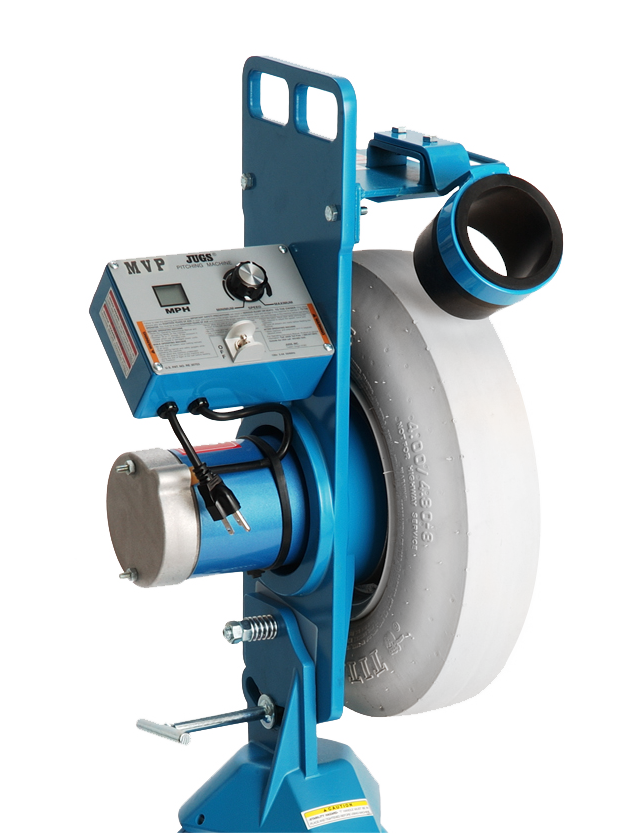
As I said earlier, a lot of people don’t want to shell out big bucks for a pitching machine. And that’s understandable. However, if you want a pitching machine that’ll be useful for different drills, supports both baseball and softball, and is easy to use, move, and set up, there’s no better alternative than the Jugs MVP Combo.
There are so many things to love about this machine that it’s hard to just pick one. All the little annoying discomforts you could think of are already taken care of thanks to the design of the Jugs MVP. For instance, the machine supports both baseballs and softballs.
So, let’s say you’re a coach who, because of unavoidable circumstances, has to guide baseball and softball players. The Jugs MVP has got you covered. Whether it’s professional baseball or softball, I’ve used both to get the most out of my hitting and fielding drills.
Plus, the speed is adjustable. You can set it up from 20 to 60 mph depending on the hitter’s age, preference, and drills. With little leaguers, I don’t have to go beyond 35-40. You can go higher for high schoolers or even adults.
I loved that the height was adjustable as well. I could easily use this pitching machine to target high or low strike zone areas to help the batters understand different pitches. There’s another advantage of the height adjustment that goes unnoticed. You can actually use this machine for rising tee-ball stars.
One more thing- I’ve had no trouble carrying this pitching machine to and from work. The 56lbs weight didn’t pose a challenge that my body couldn’t handle. In fact, if you break it down into different pieces, you can stash it in the trunk without any trouble.
The only issue you might have with this otherwise incredible pitching machine is the price point. Current pricing sits right around $1,595 direct from Jugs, and I know that doesn’t fall into oh-so-comfortable territory. However, the investment can be worth it depending on what you want to do with the machine.
Also, you have to attach it either to a power outlet or portable generator to make it work. It’s a bother, true. But once you take the time to set it up, you’ll be really happy with the results.
If you’re a coach like me, definitely get one for your school or trainees. If your family has two or more baseball or softball aspirants, the money spent would be worth it. And before I end this Jugs pitching machine review, I should mention that your dough’s safe with a multi-year warranty from Jugs.
So, people who want their kids to take their game to the next level should invest in the Jugs MVP Combo.
Details:
- Speed: 20-60 MPH
- Weight: 56lbs
- Compatibility: Baseball and Softball
- Adjustable: Yes
- Type: Electric/Generator operated
2. Louisville Slugger Blue Flame Pitching Machine (Best Manual)
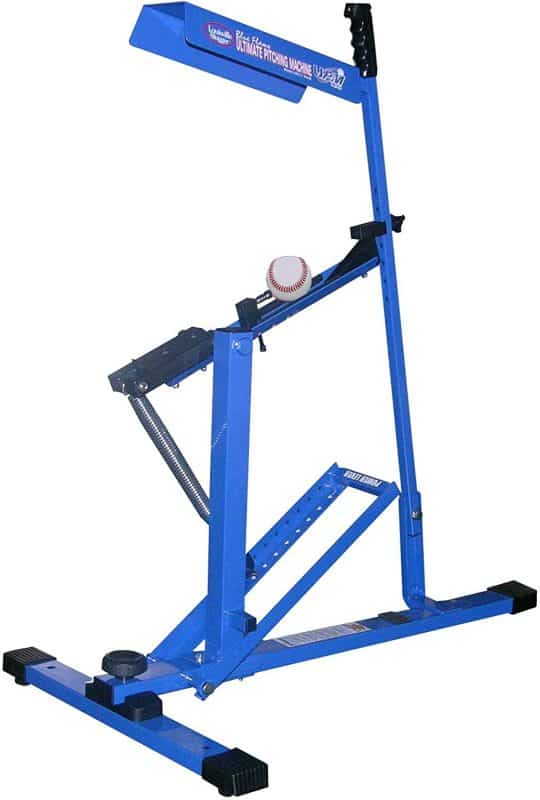
I’ve already covered a pitching machine that can put a dent in your wallet, and it’ll be worth the dent, though. So, I thought I should balance it out by talking about an excellent budget machine. Even I wasn’t always able to afford high-end machines at first. The Louisville Slugger Blue Flame was my go-to before I moved on to the big-boy pitching machines, and it’s still one of the most popular manual pitching machine picks for youth and high school hitters in 2026.
Unlike the Jugs MVP, this pitching machine has a smaller speed adjustment range. However, the 18 to 45 MPH it gives you is more than enough to train youngsters and high schoolers. Adults who aren’t really going into MLB can also hone up their batting skills to impress friends and colleagues in the next weekend match with this speed as well.
And yes, the 45 MPH speed limit only applies if you’re using professional balls. If you’re using something lightweight like plastic, the speed goes up.
What I didn’t expect from a budget machine is dual compatibility. I thought it would either be a dedicated baseball or softball pitching machine. Well, I was glad to be proven wrong because this little cheap (in a good way) beast can do both.
Plus, the Blue Flame weighs less than the Jugs MVP. So, you’d have an easier time moving it around. However, setting it up the first time is quite complicated. Sure, the instruction manual will guide you. But it’s not simply place, fasten, and go.
You need to take the time to understand how all the little pieces come together. But once you get the hang of it, it’ll not be a major problem anymore.
A lot of people get the Louisville Blue Flame over any other high-end machine. And there’s a good reason for it. You don’t need a consistent supply of electricity to run it. That’s huge. You use a foot pedal and lever to load and throw the pitches manually, no batteries, no generator needed.
However, the no-power wonder is a double-edged sword. An adult has to be there to supervise the entire process. You can leave it to the kids. But I wouldn’t recommend it because the lever’s kickback is dangerous.
Judging the Louisville Blue Flame from the price point, it’s a sweet not-to-be-missed deal, usually well under $200. It’s a combo pitching machine. The lightweight build is more than manageable. You don’t need an electricity supply.
If you’re still skeptical, you should know that this machine has made its way to being the official pitching machine for Babe Ruth Baseball and Softball league. So, that alone is a testament to its performance.
Details:
- Speed: 18-45 MPH
- Weight: 25lbs
- Compatibility: Baseball and Softball
- Adjustable: Yes
- Type: Manual operation
3. Hack Attack Baseball Pitching Machine by Sports Attack (Best Premium)
The pitching machine I’m about to highlight now isn’t everyone’s cup of tea. Why? I’ll get to it.
The first couple of machines I presented are only good for junior players and high schoolers. These machines don’t have the needed speed, pitch variety, and consistency. Adult baseball players need a lot more features to improve their game. And that’s exactly what the Hack Attack Baseball Pitching Machine offers.
Before I dive in, this machine is really expensive. Not a lot of people who want a machine for simple drills or just want some weekend fun can afford it. And I think that’s okay. The Hack Attack Baseball Pitching Machine isn’t meant for casuals. It’s a professional pitching machine preferred by MLB pros. So, that’s how the price point is set as well.
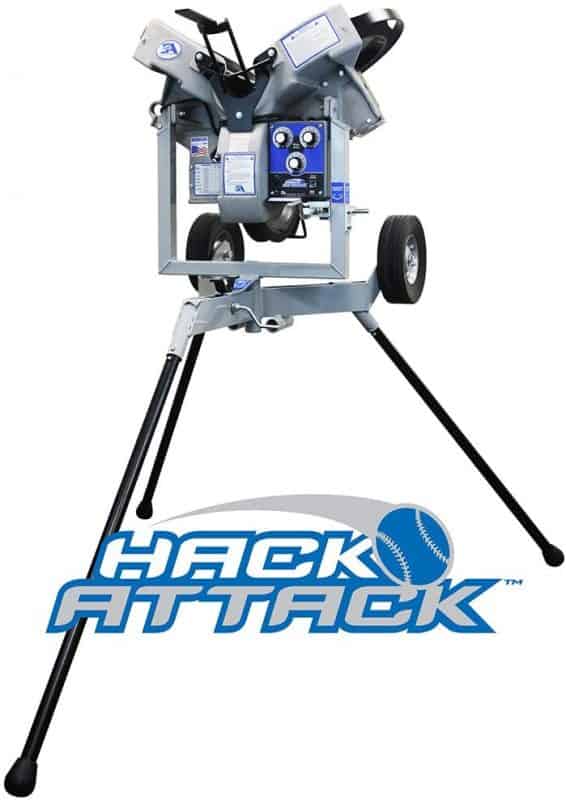
The Hack Attack has three-wheel pitching mechanics. If you’ve looked at the pictures of the Jugs BP1 and Jugs MVP, you’ll see that they have one wheel. Now, that makes a huge difference. The one-wheeler pitching machines can only throw rising fastballs or sinkers. Even these pitches won’t be perfect.
However, the three-wheel design gives you so many pitching options. Whether it’s a cutter, a slider, a curveball, or a splitter, the Hack Attack has got you covered. The many pitching options coupled with a 100+ MPH speed is what makes it a favorite of professionals.
A common problem with high-speed pitching machines is an unstable base. The force from the machine can be a bit overwhelming at times. But the leg clamps keep the machine rooted in place.
Plus, you can do a lot of different and difficult fielding drills using the Hack Attack. Usually, one-wheel machines are only good for pop-flies or groundballs. But in a real game the ball can come at you with a lot of swerves and swings due to unexpected bat-to-ball contact. So, this machine can give you a true fielding experience.
I used to do a lot of swerving flyballs and super-fast groundballs to get my fielders ready for the game.
Also, the machine has a Hulk-buster build. And if you’ve followed along until now, you probably realized that it’s not a compliment I bestow often. The machine’s body can resist a lot of elemental damage. And if by any chance you find a performance issue, you can always fall back on the manufacturer’s warranty.
In short, the Hack Attack Baseball Pitching Machine is for serious players only. It’s expensive, yes. It has a ton of features, hell yeah. So, if you want to reach the heights of MLB pros, the investment you make in this machine will pay huge dividends.
Details:
- Speed: 35-100+ MPH
- Weight: 135lbs
- Compatibility: Baseball
- Adjustable: Yes
- Type: Generator/Electric Operated
4. Franklin Sports MLB Electronic Baseball Pitching Machine (Best Pitching Machine for the Money)
Pitching machines don’t always cost more than $100. Some come at a price point of only $30-$40. The Franklin Sports MLB Electronic Baseball Pitching Machine falls in the latter group, and it’s still one of the most searched-for cheap pitching machines going into 2026. Fair warning, a super cheap machine like this will have limitations you need to accept. So, if you’re not the person who loves a little bit of DIY tweaking, you better not go for pitching machines under $50.
For starters, this machine is suitable for young and coming baseball players. If you’ve got a tee-ball superstar in your family or a little-league champ, the Franklin Sports MLB will be an excellent addition to their daily hitting drills. It’s a good starter pitching machine for youth players who aren’t ready for a full-size unit yet.
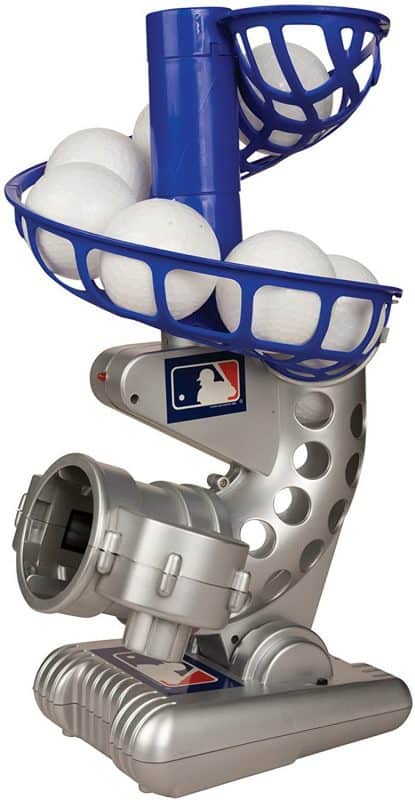
The machine can hold up to 9 balls. And unlike the Louisville Slugger Blue Flame, you don’t need anyone standing next to it. It’ll keep throwing a ball at you every 7 seconds. Plus, 6 balls are already included in the basic package, a sweet deal.
Before the balls zoom your way, there’ll be a red flash. So, if your young tee-ball star is practicing, there won’t be any unwanted surprises. No additional power source is needed like the Jugs MVP Combo. However, you need six batteries. So, be prepared to spend a few extra bucks.
The Franklin Sports MLB has a few pitch settings. However, the adjustments aren’t lateral. It’s vertical. So, you can emulate some slow-pitch deliveries. But you can’t really get cutters or sliders with the settings present in this pitching machine.
The price point of this machine is incredible. But there’s a catch. It’s a starter pitching machine meant for kids. If you want to have some fun with it as an adult, you can. The plastic balls are safe for windows. So, you’ll get to knock yourself out in the backyard.
Still, the 20MPH speed limit without any adjustments, limited angles, and 7-second predictable interval hold the Franklin Sports MLB pitching machine back from being a long-term training tool.
Despite the drawbacks, I am still a big fan of this pitching machine. Let’s face it, there aren’t many good cheap pitching machines out there. The handful available are either complete trash or somehow manageable, nothing amazing.
Compare the other cheap youth pitching machines to the Franklin MLB, and you’ll see that it’s a clear winner. I’ve also broken it down in a dedicated Franklin MLB pitching machine review if you want a closer look before buying.
Details:
- Speed: 20 MPH
- Weight: 3.5lbs
- Compatibility: Only lightweight plastic balls
- Adjustable: Limited
- Type: Battery Operated
5. Jugs BP1 Baseball/Softball Combo (Best Combo Pitching Machine)
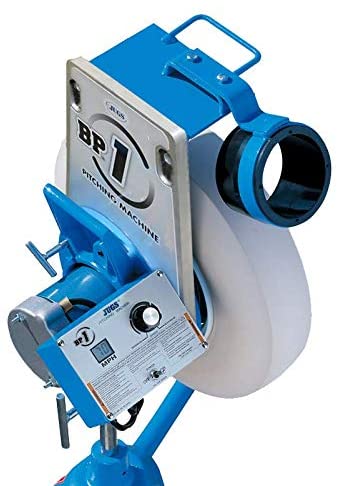
All the machines I’ve talked about so far are really good but they lack versatility to some extent. That’s why I’ve added another Jugs machine to the party. If you want a semi-pro machine to practice both hitting and fielding drills, you should look into the Jugs BP1.
A lot of the Jugs BP1’s features are similar to the Jugs MVP. However, there are a few key distinctions that justify the extra buck you spend. For starters, the MVP Combo has a top speed of 60 MPH. In contrast, with the BP1 you can get 70 MPH top speed with ease.
Even the low-speed setting is better on this machine. The MVP’s 20 MPH is topped by the 15 MPH you get from the BP1. So, if your little champ is struggling with 20 MPH or higher, you can just set the speed down to 15 MPH and work your way up. There’s a digital readout display that helps with setting the speed a bit.
You can use a number of different ball sizes and types. I use the BP1 for both baseball and softball. It’s a combo pitching machine similar to the Jugs MVP. So, if your cohorts want softball and baseball action, there won’t be a problem.
Apart from the speed settings, what truly puts the Jugs BP1 above the Jugs MVP is the 360-swivel design. Some people have a misconception that pitching machines are only for hitting drills. Well, that’s far from the truth.
You can get a lot of infield and outfield training done with the right pitching machine. That’s the power of the 360-swivel design. All you have to do is adjust the height, rotate the wheel for either flyball (outfield) or groundballs (infield), and swivel the machine, voila.
I’ve used the BP1 for a long time. And the only drawback I can think of is the price. It’s a noticeable step up from the Jugs MVP. And you have to get a Jugs battery pack or a compatible portable generator if you don’t have a 110V power outlet nearby, putting more dent in your wallet.
However, the swivel design, the added speed options, and the ease of adjustment more than make up for it.
Plus, the 75lbs weight isn’t for everyone. It can be a bit difficult to move unless you know how to roll it away using the wheel.
Still, the Jugs BP1, despite a few shortcomings, is an amazing pitching machine. You can take this and use it for a machine pitch baseball league. So, it doesn’t just have to be for fielding and hitting drills. It’s a multipurpose tool worth every green you spend on it.
Details:
- Speed: 15-70 MPH
- Weight: 75lbs
- Compatibility: Baseball and Softball
- Adjustable: Yes
- Type: Battery/Generator Operated
6. Heater Sports Deuce 95 (Best for Breaking Balls)
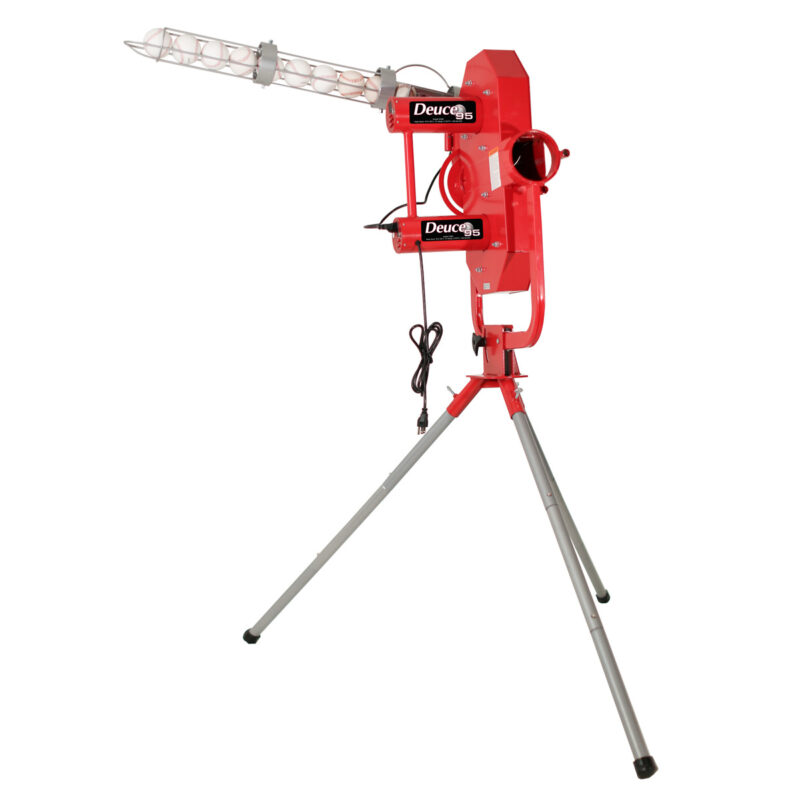
This one’s new to the list, and I added it because it fills a gap none of the other machines here really cover well: a true dual-wheel machine at a mid-range price. The Heater Sports Deuce 95 has become one of the more popular picks in the last couple of years for families and travel teams who want breaking-ball practice without spending Hack Attack money.
The two wheels spin independently, which is what actually lets a machine throw a curveball or slider instead of just a straight fastball. With the Deuce 95, you get fastballs up to 95 MPH with real baseballs (and a bit more with lite balls), plus curves and sliders you can throw left or right-handed. That’s a real step up in pitch variety compared to the single-wheel machines on this list.
It comes with a 12-ball auto feeder built in, so nobody has to stand next to the machine feeding balls by hand. The wheels are fully enclosed for safety, which matters a lot if you’ve got younger kids or curious siblings hanging around the cage.
It runs on standard 110V power, with an optional battery pack if you want to take it to a field without an outlet nearby. At around 95lbs, it’s not the lightest machine here, but it’s still manageable for one adult to load into a truck bed or SUV.
The only real downside is that it’s louder than the air-propelled machines like the Zooka, and the auto feeder mechanism needs occasional maintenance to keep balls feeding smoothly. Still, for the price, it’s one of the better values if breaking-ball practice and pitch variety matter more to you than pure portability.
Details:
- Speed: Up to 95 MPH (105 MPH with lite balls)
- Weight: 95lbs
- Compatibility: Real baseballs and lite balls
- Adjustable: Yes (independent dual-wheel speed control)
- Type: Electric (110V), optional battery pack
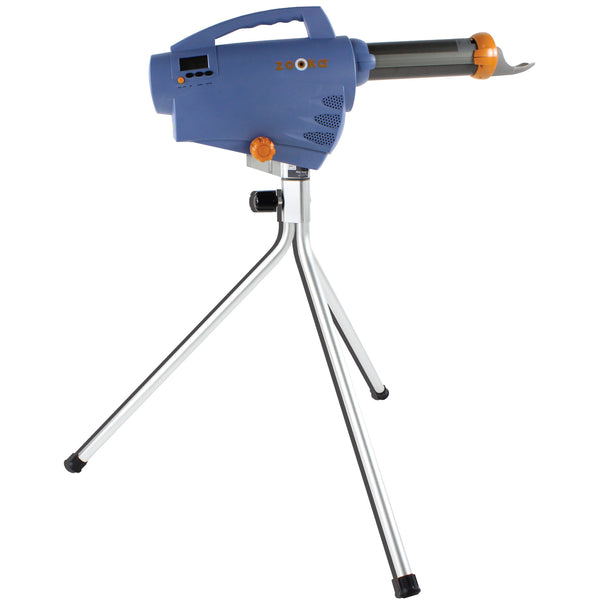
7. Zooka ZS740 (Best Portable Pitching Machine)
I get that the Hack Attack pitching machine I just covered above isn’t for everyone. And that’s alright. I’m not asking you to go all-in on Hack Attack machines if you’re not dealing with high-end adult professionals.
So, if you’re more into casual baseball drills, but with a slight competitive touch, the Zooka ZS740 should be right up your alley. It’s not as cheap as the Franklin pitching machine, but it’s cheaper than most of the other pitching machines I’ve mentioned above. So, your wallet can breathe a sigh of relief.
If I had to use two words to define this machine, I’d say it’s a “glorified airgun.” Yes, you’ve heard it right. Unlike the one-wheel, two-wheel, or even three-wheel machines, the Zooka ZS740 bursts air out of a long pipe, propelling the ball forward.
Now, you might think that an air-propelled pitching machine would lack the necessary force to generate speeds over 50 MPH. Well, this couldn’t be farther from the truth. The ZS740 has enough punch to actually dish out 70 MPH.
Another huge perk of this budget-oriented machine is the automated changeups. We all know that zero variation in pitches can create bad batting habits. However, with the ZS740 I was able to program the delivery timings. And this kept the hitter on their guard because they won’t know when the ball is coming towards them.
Also, the entire system is password protected. Not a feature I’ve seen in many other pitching machines, to be honest. It can be redundant if you keep it safe inside the practice room. But when you’re outside, it’s nice that the kids can’t mess around with the machine unless they have the password.
The Zooka ZS740 has a few issues you need to work around. The biggest is that you shouldn’t use leather baseballs. The compressed air can damage the leather, ruining the exterior of leather baseballs over time.
Apart from that, the battery directly affects the machine’s performance. As the battery power goes down over a session, the pitches will start lacking power.
Still, the rechargeable battery that’s included is rated for years of typical use, so you’ll get a lot of use from it before it starts to show signs of weakness.
Plus, at under 30lbs with the tripod, it’s genuinely one of the easiest pitching machines to carry to a field, set up in under a minute, and break back down. If portability is your top priority, this is still the one I point people toward.
Details:
- Speed: 10-70 MPH
- Weight: Under 30lbs
- Compatibility: Baseball
- Adjustable: Yes
- Type: Battery Operated
8. Jugs Small-Ball Pitching Machine

If you’re already knee-deep into this review, you’ve already seen a whole heap of different pitching machines. What if I tell you that there’s still more? I know, it can sound overwhelming. But bear with me. The Jugs Small-Ball Pitching Machine isn’t designed like one of Batman’s suits. So, unlike the Hack Attack, you’ll have an easy time understanding what this machine has to offer.
Romeo once said, “what’s in a name?” But with the Jugs Small-Ball, it’s actually all in the name. This machine throws specific balls manufactured by Jugs only. And you’ve guessed it, they are smaller than the average-sized baseball or softball.
So, you’re probably wondering, why on earth would I want something that throws small balls? Well, the thing is, a lot of skilled hitters try to work on their depth perception. If you’re not familiar with the term, it’s actually observing and assessing the whole dimension (height, width, and depth) of an object.
Hitting a smaller ball helps you improve depth perception. Simply put, your accuracy numbers will soar once you take this baby out for a day or two.
Plus, it has multiple speed settings, some for fastballs and some for curves. I never expected a budget pitching machine to throw curveballs. Although the pitch consistency is nothing to write home about, the curveball feature being there is way more than I could ask for in a budget machine like this one.
And it’s really one of the best small-ball pitching machines out there. It weighs 23lbs only. So, you can carry it around easily without putting any stress on your upper-body muscles. Setting the pitching machine up takes a few minutes as well.
The top speed of the machine is about 30 MPH. A lot of people misread the “simulated 75 MPH” portion. When the word “simulated” is attached to a speed metric, it doesn’t give you the entire story. “Simulated” speed accounts for the hitter’s reaction time, so the speed isn’t actually 75, but it feels like it because of the machine’s distance and small ball size.
Still, I don’t mind the low speed. It’s a training tool, not a radar-gun machine. And low speed is a drawback I can live with.
I think the Jugs Small-Ball Pitching Machine is a bang for the buck. You get a machine that can do curveballs, is easy to move around, and works well for basic fielding drills, with an auto-feeder to boot.
If you want to surprise your baseball or softball fanatic kids for their birthday, the Jugs Small-Ball is a fun gift to get.
Details:
- Speed: 30 MPH (Simulates 75 MPH)
- Weight: 23lbs
- Compatibility: Only manufacturer-approved polyurethane foam balls
- Adjustable: Yes
- Type: Battery/Generator Operated
9. First Pitch Baseline Pitching Machine

The pitching machine I’m going to talk about right now is not the cheapest out there nor is it the costliest. This one falls into the mid-range category and is a value purchase if you are planning to use it for youth or high school baseball players. So, without further ado, let’s jump into the details of the First Pitch Baseline Pitching Machine.
I will start off with the build quality of the product. Unlike other pitching machines, this one is made of 1/8″ heavy gauge steel. So, you can already guess the durability of the unit. Yes, it is quite durable and strong enough to withstand accidental impacts.
Before talking about the motor casing, let me brief you on the power system of the pitching machine. It is automatic and runs on 110V. So, you’ll need a power outlet of 110V or a generator to run the unit.
It is a little risky to use an electrical unit when you are surrounded by teenagers or kids. However, with the First Pitch Baseline Pitching Machine, you don’t have to worry because the motor is sealed inside a tough steel casing. The control panel also comes with the same steel housing for further security and protection.
Apart from that, the machine can throw both softballs and baseballs of 11 or 12 inches. The reversible legs allow you to adjust between softball and baseball mode without the help of any tools. It has a swivel base, meaning you can rotate the machine 360 degrees. Hence, you can train catchers as well.
With the pitching machine, you can throw softballs at 0-60 mph and baseballs at 0-70 mph. You can also adjust the machine to throw fly or ground balls. Thus, you have complete control over what type of ball you want your hitters or catchers to receive.
One last, yet one of the best things about the product is that it comes with a solid limited warranty. So, you are always backed up from accidental damage.
Details:
- Speed: 0-70 MPH with baseball and 0-60 MPH with softball
- Weight: 50lbs
- Compatibility: Softball and baseball
- Adjustable: No
- Type: Automatic/Power-operated
10. Louisville Slugger Black Flame Pitching Machine

If you are running short on budget, yet still plan on continuing training sessions with your students or kids, then you should have a look at the Louisville Slugger Black Flame Pitching Machine. It is very cheap, yet performs decently. The product is an excellent entry-level pitching machine. Therefore, if you are planning to start somewhere, you can start with this one. I actually cover it in a lot more depth in a separate Louisville Slugger Black Flame pitching machine review if you want the full breakdown.
First of all, the Black Flame is a manual pitching machine. There is no need for generators, power outlets, or charging. Everything is right there with the pitching machine, just place the ball, use the foot pedal and the handle to launch the perfect pitch.
No electrical cords or motors means less weight as well. Yes, you guessed it right, the Black Flame pitching machine weighs only 24lbs. Moreover, it is compact and can be carried anywhere easily. So, you of all people will never be late for a practice session. However, no automatic mode means that you’ll have to manually control everything, which sometimes can get a little annoying.
Apart from that, the machine allows you to pitch fly, ground, fast, and slow balls. It is compatible with almost any type of ball. You can use it to pitch baseball and even softballs. Hence, if ever for some reason you need to pitch softballs, don’t worry because the Black Flame pitching machine has you covered.
As for speed, the machine can throw a ball at a rate of 18MPH to a maximum of 50MPH. It is quite durable and can last for a couple of years with proper maintenance and care.
While using the pitching machine, I’ve noticed that it has a hard time locking down to the ground. If you don’t lock or secure the machine to the ground, it will move a bit when you are using it to throw fastballs.
In any case, it is an excellent product when you compare it to other pitching machines in the same price range. Usually, budget-friendly pitching machines come with poor quality material, so they don’t last more than a few months.
Judging by the price, the machine is worth the deal. Think of it as something for the young kids and not for professional players.
Details:
- Speed: 18 to 50MPH
- Weight: 24lbs
- Compatibility: Almost all types of balls
- Adjustable: No
- Type: Manual
11. Sports Attack Junior Hack Attack Baseball Pitching Machine

Finishing off my list with another pitching machine from Sports Attack. If you have checked out the previous reviews, then you should already have an idea about the performance, quality, and price range of their pitching machines. I also wrote up a dedicated Hack Attack Junior pitching machine review if you want more detail before you commit.
As mentioned before, the units from Sports Attack are not at all budget-friendly. However, the features and performance you get for the price are unrivaled. The same goes for the Sports Attack Junior Hack Attack Baseball Pitching Machine. Yes, it is a little costly but totally worth the deal.
If I start talking about all the features and benefits, it is going to feel a little overwhelming. Therefore, I’m only going to talk about the aspects that matter the most.
So, the first thing you need to know about the Junior Hack Attack pitching machine is that it is a three-wheeler unit. It means you’ll have a better view of the ball while practicing, better overall accuracy, and better speed control of the ball.
Due to the three-wheel system, the machine can pitch split fingers, knuckles, sliders, curves, and fastballs that go up over 70MPH. It also provides excellent spin control, which makes hitters feel like they are facing actual pitchers.
Hence, the machine is suitable for training sessions at all levels, from high school to professional league. Apart from that, the product comes with throwing wheel guards for safe operation. It also features pitch elevation control (adjustable handle), which you can use to move the pitch up or down.
The machine comes with speed knobs or dials and a pitch selection chart. You can use the chart to adjust the pitch using the knobs for the perfect pitch.
A few things I like about the machine are that it’s lightweight, compact, and portable for its class. You can carry it in the trunk of your car, but make sure to place it on its side. The machine is also easy to set up thanks to the quick-release legs, which let you set the machine up in a few seconds.
Overall, the pitching machine comes with everything you need to guide youngsters or even senior-level players in learning how to hit the perfect shot.
Details:
- Speed: Up to 70+ MPH
- Weight: 75lbs
- Compatibility: Baseball and Softball (Needs accessories for softball)
- Adjustable: Yes
- Type: Generator Operated
How to Choose the Best Pitching Machine – Buyer’s Guide
Once you read the detailed breakdowns that I’ve discussed till now, you’ll get an idea of how unique each pitching machine can be. So, it’s difficult to just point your finger at one and call it the best pitching machine. That’s just not how it works. You need to understand a few things-
- Why you’re getting it?
- Who you’re getting it for?
- What kind of drills do you have in mind?
- What level of performance are you expecting?
- And what sort of moolah do you have?
So, I’ll give you a quick tour of the factors that’ll help you have a smooth ride. Once you keep in mind the things I mention below, you shouldn’t have a problem choosing what’s best for you.
One-Wheel vs. Two-Wheel vs. Three-Wheel – Which Road to Take?
The first question you need to address is how many wheels do you want in your pitching machine. It’ll be better if I explain the benefits and shortcomings of each and how a pitching machine actually generates pitch speed and movement in the first place, which comes down almost entirely to the wheel setup. So, let’s get straight to it.
One-Wheel:
One-wheel pitching machines are everywhere. Most people usually go for these because they’re cheap and lightweight. So, if you want a pitching machine for tee-ball players or high-schoolers, a one-wheel pitching machine should be just fine.
The biggest perk of getting a one-wheeler is that it’s really cheap. You can move it around with ease. And the pitching variety is decent enough to have some hitting and fielding drills done. So, it’s a well-rounded machine for beginners.
As you can see, most of the pitching machines I’ve reviewed in this article are one-wheelers. Why? Because it’s the most viable option for casual to mid-tier players.
However, put next to three-wheel machines, one-wheelers pale in comparison. One-wheel machines don’t have a ton of features needed to cater to hitters who want to go pro.
Two-Wheel:
Two-wheel is kind of like the jack of all trades but master of none. So, you’d get a professional flavor but not the whole dish. A two-wheel pitching machine has some pitch variety, including basic breaking balls, since each wheel can spin at a different speed. But it’s still not quite in the league of three-wheelers.
Basically, it’s a mid-range pitching machine. It won’t break your bank, and you’ll still get a lot of use out of it. These machines are perfect for high-schoolers and travel teams who want more than a straight fastball.
Three-Wheel:
All professional or MLB-tier machines are three-wheelers. There’s pitching consistency, variety, left-right throw flexibility, fungo work, and a ton of other features that I can keep yapping about.
You can do a lot of advanced hitting and fielding drills. It’s not just for high-schoolers. Three-wheel machines are kind of all-in. Once you invest in a three-wheeler, you know you’re committed to baseball or softball.
Usually, these machines aren’t purchased by a family or a single person. Coaching organizations prefer three-wheelers. The biggest issue with these machines is that the features come with a huge price tag. So, know what level you’re currently at, where you want to go, and whether you’re willing to make the huge investment.
Pitching Machine Speed by Age and Skill Level
Short answer, speed settings are important. But if a machine doesn’t have the exact speed you want, it’s not the end of the world. You can always work around it. Let’s say you get 50 MPH from a machine. If you need more, what you should do is bring the machine closer to the hitter.
I know, it’s not ideal. But high-speed machines aren’t cheap. So, if you want a budget machine with speed variety, change the hitter-to-machine distance.
As a rough guide for pitching machine speed by age: tee-ball and 6-8 year olds usually train around 20-35 MPH, 9-10 year olds around 35-50 MPH, middle schoolers around 50-65 MPH, and high schoolers 65-80+ MPH. Adult players need speeds of 80-100+ MPH to get anything close to game-realistic reps. So, know who you’re buying it for before thinking about speed settings. If you’re shopping specifically for younger players, it’s worth cross-checking against our dedicated list of the best pitching machines for Little League, since that guide is built entirely around youth speed ranges and safety.
A Combo or a Dedicated Machine
Again, the solution to this dilemma boils down to whether you want something professional or casual. Combo machines support different types of balls, baseball, softball, dimple balls, etc. So, if you get a baseball-softball combo, you can use the machine with both balls.
Alright, so what’s the catch? Why get a dedicated machine when you can hit two birds with one stone?
Simple, dedicated pitching machines are better at what they do. Combo machines are versatile, yes. But when it comes to performance, single-game machines will always triumph over something that’s trying to juggle a lot of balls at once. Get it?
Portable vs. Stationary Pitching Machines
This factor can come off as complementary or contradictory when I’ve put it right after praising single-game machines. Well, versatility isn’t all about being compatible with different balls. There’s a lot more, and portability is one of the biggest things people overlook until they actually have to load a machine into a car every week.
For instance, the more speed settings you have, the better flexibility you have. Plus, machines that can be separated from the base are useful tools for fielding drills as well. Take the Zooka ZS740 for example. You can take it apart from the tripod base, point it in any direction like a gun, and shoot flyballs for outfield practice. A true portable pitching machine like the Zooka or the Louisville Slugger Blue Flame trades some top-end speed and pitch variety for the ability to set up practice anywhere in five minutes, while a stationary machine like the Hack Attack rewards you with more features once it’s parked in a permanent cage.
So, be sure to check what the pitching machine can do. Is it just for hitting drills? If so, what type of drills can you get? Can you use it for fielding drills? If so, what options do you have?
Ask yourself these questions before deciding.
Go Budget or High-End
This factor is related to the one, two, and three-wheeler questions. While the price of a pitching machine doesn’t entirely depend on the number of wheels, it has a direct bearing. More wheels equals more features equals more dough spent.
So, the rule of thumb here is, why do you need the pitching machine? If it’s for your kids to practice in the backyard or on the field, a budget machine would do the trick. But if you want to lead and organize a machine pitch league, you need to up the ante.
Finally, if you want something on an MLB level, you need to invest a whole lot more. If you look at the price difference between the Jugs BP1 and the Hack Attack by Sports Attack, you’ll get a clear idea. You can see the full range for yourself in our breakdown of what a pitching machine actually costs.
Understand what you want from the machine and purchase accordingly. Just because something is expensive doesn’t mean it’ll serve your needs.
Automated or Manual, What’s Better?
If you don’t mind manning the machine, there’s no harm in using something manual like the Louisville Slugger Blue Flame. I think manual machines are perfect for training youngsters. Coaches have to monitor the drills of little leaguers anyway, so a manual machine gives you the added incentive of being there.
Plus, with a manual pitching machine, there’s no extra cost. Usually, automated machines need a portable generator or battery packs. Almost always, none of these power sources are included with the machine. So, you have to spend some extra cash to get it going.
However, automated machines are more comfortable and they have tons of options. You can’t get curveballs, splitters, or any advanced pitches from a manual machine. Also, automated pitching machines have higher speed settings.
And manning the manual machine for a long time can take a toll on your body. So, you get to choose, whether you want to shell out more money or put your body on the line.
Balls and Safety Gear You’ll Actually Need
One thing a lot of first-time buyers miss is that the machine itself is only part of the setup cost. Depending on the model, you may need specific pitching machine balls (some machines only work with the manufacturer’s lite balls or foam balls, not regulation baseballs), an L-screen to protect whoever’s feeding the machine, and a net or backstop behind the hitter to catch missed swings. I put together a full breakdown of which pitching machine balls you’ll need for each type of machine if you want to avoid buying the wrong ones.
Budget for this stuff up front. It’s an easy corner to cut when you’re already stretching to afford the machine, but a $30 net is a lot cheaper than a chipped tooth or a cracked windshield.
FAQ
A few common questions about pitching machines answered by yours truly.
What pitching machines do MLB teams use?
There isn’t one specific answer. Any three-wheel machine is MLB-tier. The Hack Attack by Sports Attack is used by MLB teams. There’s also dual-wheel machines like the Heater Sports Deuce 95 for lighter work, and a handful of other incredible three-wheel pitching machines used in pro facilities.
Are pitching machines worth it?
It’s debatable, but I think pitching machines are worth the money. Yes, if you’re not using it properly, you run the risk of getting into bad batting habits. But with a veteran coach by your side, the automated changeups will make sure you don’t train your muscles the wrong way. So, once you use the pitching machine correctly, it’s worth it.
Do professional baseball players use pitching machines?
Yes, they do. Back in the days when machines were simply overhyped ball shooters, pitching machines were looked down upon. But the story is different now. You can get changeups, curveballs, splitters, and so much pitch variation that it’s impossible to guess when the ball’s coming at you and at what speed and movement. So yeah, thanks to the new and improved tech, professional players do use pitching machines.
How much is a pitching machine?
The price range of pitching machines is wild. In fact, the difference is so huge that people often get confused. Pitching machine prices go from around $30 to $5000, crazy, right? A decent machine for serious youth or high school training would cost around $1000-$2000. If you want a top-shelf, MLB-caliber machine, be prepared to spend $3000-$5000 or more.
What is a good pitching machine speed for a 10 year old?
Most 9-10 year olds train comfortably in the 35-50 MPH range. That mirrors what most kid pitchers can actually throw at that age, so it builds realistic timing instead of bad habits. You can always dial it down further while they’re first getting used to a machine, then work your way up.
Are portable pitching machines as good as stationary ones?
For youth and casual training, yes, a good portable pitching machine like the Zooka ZS740 or a manual machine like the Louisville Slugger Blue Flame will cover almost everything you need. Where portable machines fall short is top-end speed and advanced pitch variety, since three-wheel professional-grade machines tend to be heavier and less convenient to move. If you need MLB-level velocity and movement, you’re generally trading away some portability to get it.
How far should a pitching machine be from home plate?
It depends on the age group and the speed you’re throwing. Youth setups are often closer than a regulation mound, sometimes 35-46 feet, to account for slower reaction times, while high school and adult hitters typically want something closer to the real 60 feet 6 inches. Moving the machine closer also effectively increases the perceived speed, which is a trick a lot of coaches use with budget machines that don’t have a high top-end MPH.
Can a pitching machine be used indoors?
Yes, as long as you have enough clearance and a proper net or backstop. Manual machines like the Blue Flame or Black Flame and lighter electric machines like the Franklin Sports MLB are popular indoor and garage-cage options because they’re quiet and don’t need much setup room. Higher-speed three-wheel machines are usually better suited to an outdoor field or a dedicated batting cage because of the extra distance and noise involved.
Hit Your Way to Victory
Pitching machines can help you improve your hitting fundamentals and advanced mechanics as well. However, it’s true that nothing beats the practice you get from a real pitcher. The thing is, you won’t always have a pitcher to tango with. That’s where the pitching machine comes in handy.
You just adjust the settings and go to town without the help of anyone. And if you’re a coach, youngsters have an easier time hitting machine balls, so they become motivated to face real pitchers over time. So, time for recommendations. If you’re on a budget leash, try the Jugs MVP Combo. If it’s still too expensive, take a look at the Louisville Slugger Blue Flame. And if breaking balls and pitch variety matter more to you than pure budget, the Heater Sports Deuce 95 is the newest addition here worth a serious look.

With 4 years of Division II experience, a .272 career batting average, .410 on-base percentage, and 7 home runs, I’m now in my fifth season. I’ve played baseball since age 3, alongside future MLB Draft picks, and I aim to pursue a career in baseball professionally, be it playing, coaching, or scouting.