
You grew up loving baseball. Maybe you even dreamed about going pro before life got in the way. Now you want your son or daughter to catch the same bug you did.
The trick is starting them young enough that they fall for the game on their own instead of you forcing it on them. Work on the fundamentals of hitting early, and your kid will have a real head start once they’re competing against kids their own age.
And honestly, all that time you spend training together is going to do more for your relationship than almost anything else you could do with them.
I’ve used a lot of pitching machines to train young hitters over the years. But when you’re working with a kid who’s just starting out, you can’t reach for the same machine you’d use with a 12U travel team. A serious pitching machine costs serious money, and it can be way too intense for someone who’s never squared up a pitch in their life.
That’s where the Franklin Sports MLB Electronic Baseball Pitching Machine comes in. It’s one of the most affordable pitching machines you can buy, and it’s built specifically around what a total beginner actually needs.
I picked one up to put it through its paces with my own kid, and I’m sharing everything I found in this Franklin MLB pitching machine review, including whether it’s still worth buying in 2026.
Franklin Sports MLB Electronic Baseball Pitching Machine
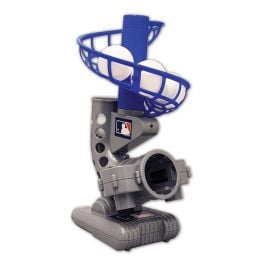
The first thing that jumps out about this pitching machine is the price. You’ll find it for well under $40 at retailers like Amazon, Walmart, and Franklin’s own site, which is honestly wild for what it offers. It’s not going to blow anyone away with speed or fancy pitch types, but it does exactly what it needs to do: get your kid excited about hitting.
That’s actually why I keep it in the conversation whenever people ask me about the best pitching machines for little league. Not because it’s going to help a kid win a championship, but because it builds the habit of squaring up a ball through real repetition.
Franklin built this machine for kids roughly 4 to 12 years old. Once your kid starts controlling their swing with any consistency, it’s time to graduate to something more advanced, or just get them in against a live arm.
One other detail I like: it comes with a basic automatic ball feeder, so you’re not standing there hand-feeding balls into a hopper between every pitch. That frees you up to actually coach instead of playing ball boy.
It also ships fully assembled. You’re looking at a couple of minutes, tops, to get it out of the box and ready to go, which matters when you’ve got an antsy six-year-old standing there with a bat.
Here’s a closer look at how it actually performs.
Pitching Accuracy
The whole point of this electronic pitching machine is training young hitters, and for that job, the accuracy is solid. It takes a try or two to get it dialed in, and because the unit is so light, it can drift out of position if you don’t anchor it down.
Once it’s set up right, though, it fires to roughly the same spot pitch after pitch. Your kid isn’t fighting an unpredictable trajectory on top of everything else they’re learning. That consistency is exactly what makes it a solid entry point into hitting a baseball.
Speed and Adjustment Options
For the price, this thing is surprisingly adjustable. You won’t get different pitch types like a curveball or changeup here. It throws a straight pitch at roughly 20 mph. But because it’s so light, you can move it closer to or farther from the plate to change the effective speed your kid sees.
It also lets you adjust the pitching angle across three settings, so you can work on different swing paths and pitch heights. Between the distance trick and the angle adjustments, you’ve got more range here than the price tag suggests.
You can even repurpose those same angle settings for fielding drills, which is a nice bonus if you want to work on more than just hitting during batting practice.
Flashing Indicator
A brand-new hitter is going to have rough timing at first, period. If a machine just fires with no warning, a beginner has almost no shot at hitting it. Franklin clearly thought about this.
The machine pitches every 7 seconds, and just before it fires, a small LED light below the chute flashes to cue the hitter. It’s a small feature, but it does a lot of the heavy lifting when it comes to teaching a kid to hit off a pitching machine for the first time.
Portability and Power
The whole unit is plastic, so it’s light enough to carry with one hand and move around the yard without any hassle. The automatic feeder holds up to 9 balls at a time, and you get six white AERO-STRIKE plastic baseballs in the box to get started.
Quick math: 9 balls at a 7-second interval gets you about a minute of pitches before somebody has to collect the balls and reload. That’s enough time to build a real rhythm, or to sneak in a few minutes of your own downtime while your kid works through a round. If you ever want a bigger stockpile so you’re not constantly reloading, it’s worth reading up on pitching machine balls and what to look for.
It runs on 6 D batteries, so there’s no cord to deal with and no outlet needed. That also means there’s little real electrical risk if your kid ends up using it without you standing right there.
Pros and Cons
- Genuinely budget-friendly, one of the cheapest real pitching machines out there
- Ships fully assembled and ready to use in minutes
- Automatic ball feeder means less time reloading, more time coaching
- Flashing light helps beginners learn timing
- Light enough for a kid to help set up and carry
- Plastic construction and plastic balls make it safe for casual home use
- Only throws a straight pitch at one speed, no variety
- Lightweight body can shift out of position if it isn’t secured
- Kids will outgrow it once they start hitting live pitching or faster machines
Is It Right for You?
At the end of the day, the Franklin Sports MLB Pitching Machine is still built for young kids. I think of it as a glorified, but genuinely useful, ball-tossing toy. It doesn’t have the power or versatility to work for a Major Division little leaguer or anyone hitting real speed. If you’re after a top-rated pitching machine for a more advanced player, this isn’t it.
But as a starter machine for a kid who’s never hit off anything but a tee, it’s a smart, low-risk buy. I used mine with my own six-year-old, and it delivered exactly what I needed: a simple way to get more reps in without turning practice into a production.
It has its quirks. The plastic housing feels exactly as cheap as the price suggests, and you’ll want to double-check the setup each time so it doesn’t wander off target. But none of that stops it from doing its actual job.
Even I mess around with it when I’m bored around the house. The plastic balls can’t do any real damage, so I get to have some fun without starting a fight with my wife over a broken lamp.
What to Get Once Your Kid Outgrows It
Once your kid starts squaring up pitches consistently, this machine has basically done its job. From there, I’d look at something like the Louisville Slugger Black Flame or the Hack Attack Junior if you want more pitch speed and durability without jumping straight to a full-size machine. Franklin also sells a step-up model, the MLB Power Pitcher, if you’d rather stick with the same brand. And once you upgrade, it’s worth brushing up on how to use a pitching machine the right way so you get the most out of it.
How Fast Does the Franklin MLB Pitching Machine Pitch?
In my experience, it throws a straight pitch at roughly 20 mph, which is plenty for a beginner learning to track and time a ball.
What Age Is the Franklin MLB Pitching Machine For?
Franklin built it for kids roughly 4 to 12 years old. Once a kid’s swing gets more advanced, I’d move them up to a faster machine or live pitching.
Does the Franklin MLB Pitching Machine Need Batteries?
Yes. It runs on 6 D batteries and doesn’t need to be plugged in, so you can set it up anywhere in the yard.
If you want an easy way to get your kid some extra reps, or you just want to have some casual fun in the backyard yourself, the Franklin MLB pitching machine is a smart, cheap pick. You won’t put a dent in your wallet even if it ends up gathering dust in the garage in a year or two. I hope you and your kid get as much out of it as mine and I did. Cheers.

With 4 years of Division II experience, a .272 career batting average, .410 on-base percentage, and 7 home runs, I’m now in my fifth season. I’ve played baseball since age 3, alongside future MLB Draft picks, and I aim to pursue a career in baseball professionally, be it playing, coaching, or scouting.