
“What are you doing with a kid’s toy?”
“Come on! Get a pitching machine already!”

I’ve heard some version of those two lines more times than I can count. But with all due respect, whoever says that doesn’t know much about hitting. Ask any professional player and they’ll tell you the same thing I tell every kid I coach. A batting tee is one of the most useful tools you can put in a hitter’s hands. It strips away the guesswork of pitch type, speed, and location so you can focus entirely on your stance, your swing mechanics, and your hitting power.
A lot of the stigma against batting tees comes from T-ball, where every kid hits off a tee before a real pitcher ever gets involved. So people assume you’re supposed to outgrow the tee as you get older. That couldn’t be further from the truth. Plenty of MLB hitters still warm up with a tee before stepping into the cage or up to the plate. If it’s good enough for the pros, there’s not much of an argument left against it.
So here’s the short answer: hitting off a batting tee is a great practice, full stop. If you want to become a more consistent hitter and clean up the small flaws in your swing to add power and accuracy, a batting tee belongs in your bag. It’ll help you build better fundamentals and turn your swing into a repeatable, reliable motion. Let me walk you through exactly how it does that.
How Does a Batting Tee Help?
A batting tee is a must-have for any hitter serious about the game. Even MLB hitters use one to warm up before they ever see a live pitch. When I was a kid, I practiced religiously with a tee my dad picked up for me, and as an ex-pro and now a coach, I still think it’s one of the most valuable training tools you can own. Here’s why.
1. Repetition is Important
Repetition is how you build muscle memory, and muscle memory is what separates a hitter who’s thinking through their swing from one who’s just reacting. The problem with live pitching, or even a good pitching machine, is that you rarely get to hit the ball in the exact same spot in the strike zone over and over.
When a pitcher throws, you have to track the ball’s speed and path before you ever start your swing. That’s a lot to ask of a beginner who hasn’t built any real reps yet. Since the ball on a tee never moves, it’s a lot easier to groove your swing mechanics and turn good habits into automatic ones.
2. Isolating Your Weakness
A batting tee also helps you isolate small flaws in your swing. Maybe your grip is off, or your shoulders dip a little at contact. Problems like these get a lot easier to spot once you slow everything down and work through your swing on a tee.
Being able to isolate the smallest issues is a huge advantage for both hitters and coaches. Since the tee holds the ball at one exact point in the zone, you can break your swing down into individual pieces and pinpoint exactly what’s going wrong, whether that’s your bat path, your hip rotation, or your balance.
3. You are Your Own Coach
With a tee in your hands, you become your own coach. Don’t get me wrong, I still think working with a real coach beats training completely on your own. But a tee that lets you adjust the height and setup gives you everything you need for a productive solo session.
It takes a bit more effort and a sharper eye on your part, sure. But since the ball isn’t moving and you’re not racing a clock, you can actually see where your issues are. I always recommend recording your swing on your phone so you can review your stance and mechanics afterward.
4. Portable and Cheap
Most batting tees break down small and fit right in a bag. I remember hauling mine to the local park with a bucket of balls to get extra reps in on my own time. And because a decent tee runs a fraction of the price of a pitching machine, most players and parents can afford one without much trouble. For around a hundred bucks, you can pick up a tee that will genuinely improve your hitting in a lot of different ways. If you’d rather not build your fundamentals from scratch on a beat-up hand-me-down, our batting tee buying guide breaks down the best options at every price point, including a budget-friendly pick in our MacGregor batting tee review.
How to Hit Off a Batting Tee
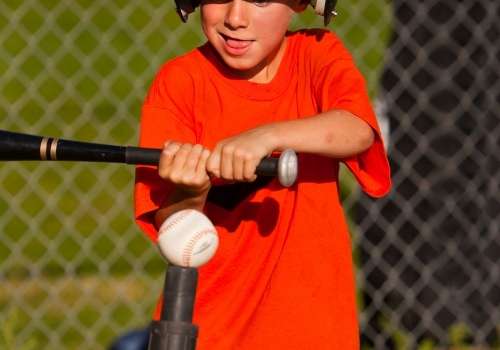
Hitting a baseball that’s screaming toward the strike zone is tough for new players, but hitting a ball perched on a tee is about as simple as it gets. You can move the tee around the zone to practice different pitch locations and hitting angles. All you really need is a bat, some baseballs, and a safe space where nobody’s standing in your line of fire.
Here’s a step-by-step breakdown of how to hit off a batting tee the right way.
Step 1: General Tee Setup and Good Practice
The whole point of using a tee is to build powerful, consistent swings and cut out bad habits. So the first step is setting it up correctly and giving yourself a visual reference to check whether you’re overstriding as you swing.
So what is overstriding?
If you’ve trained under a coach before, you’ve probably heard the term. For everyone else, overstriding is when you step too far forward with your lead foot as you swing. Overstriding can rob you of hitting power and leave your swings looking flat and weak.
The nice thing about tee training is you can set it up at different heights and positions around the plate to work different pitch locations. I’ll leave the exact setup up to you and your coach, if you have one, but if your tee adjusts in height, use that feature. It’s what gives you the most versatile training out of the equipment. For more on dialing in the right setup, check out our guide on how high a batting tee should be for your swing.
Just remember never to step your foot ahead of the tee. Set a cone or some other marker in front of you, in line with the tee, so you’ve got a reference point that keeps you honest and helps you generate consistent power.
Step 2: Proper Stance
Once your tee is set up on the plate, get into your athletic stance. The most common approach is to bend your knees slightly and stay loose. Line up your knuckles and keep a firm, secure grip on the bat. With a tee, you don’t have to worry about pitch speed or trajectory, which frees you up to focus entirely on your swing angle and strength. That said, don’t lock your eyes on the ball the whole time.
In a real game, you’ll be facing a pitcher and need to keep your eyes forward. So even when you’re training on a tee, try to picture the pitch coming in and visualize its path.
Step 3: Ball Contact
Making solid contact against a live pitcher is hard work. But when you’re hitting off a tee, it’s a lot easier to isolate your issues and fix them one at a time. As you swing, your stance needs to stay solid to deliver a clean, powerful hit.
I tell my hitters, “it’s all in the hips.” At the moment of contact, your hips should be driving toward the ball. If you’re not overstriding, your hand position should already be in good shape. Keep some space between your elbows and your body so you’ve got room for a smooth, natural swing forward.
Step 5: Follow Through
Don’t try to stop the bat the instant you make contact. If you cut the motion short, one of two things happens: either you lose power on the hit, or you get the power but can’t keep your balance. As a hitter, the second you make contact, you need to be ready to break toward first base.
If you can’t hold your balance, you won’t explode into that first step, and that’s a problem for any hitter. Extend your arms and follow all the way through your swing so the bat’s momentum doesn’t throw you off balance.
Step 6: Record Your Progress
Technically there are only five steps to hitting off a tee, but I’ll leave you with one more that’s especially useful if you’re not training under a coach. Every time you work on your swing, pull out your phone and record it. It’s a great way to track your progress, and it’s genuinely motivating to look back and see how far you’ve come.
Learning to hit is hard, and it’s even harder when you’re teaching yourself. But if you stick with it, you’ll get there and become the best version of yourself as a hitter.
What I Recommend for Hitters of All Age and Skill Levels:
Before I wrap up, let me talk about my go-to batting tee. If you’re still on the hunt for a high-quality batting tee, take a look below.
TANNER TEE The ORIGINAL Premium Baseball/Softball Batting Tee

The Tanner Original holds a special place in my training history. I spent a huge chunk of my childhood hitting ball after ball off this tee to build my fundamentals, and honestly, a lot of the hardware I picked up in high school traces back to the reps I put in on it.
I got mine as a Christmas gift from my dad back when I was just starting out on a youth team with barely any skill to my name. Thanks to this tee, I was able to build my swing from scratch. Let’s get into what makes it worth the money.
The Tanner Original comes with an adjustable frame that ranges from 26 inches all the way up to 43 inches. That range let me work my inside, outside, and middle pitches without any trouble, all with a simple height adjustment.
But the real standout feature isn’t the height range, it’s the top. A lot of cheaper tees use a stiff top that saps your power and wears out after a handful of swings. The hand-rolled Flextop on the Tanner Original is on a different level entirely.
I was pretty young when I first got this tee, so my contact wasn’t always clean, and I clipped the top more than a few times. Since the Flextop is soft and rubbery, none of those mis-hits ever damaged it.
A soft top also means you actually feel the ball as it comes off the bat, so you’re guiding your hits with intent instead of just swinging blindly. That’s one of the biggest advantages the Tanner Original has over cheaper alternatives.
It’s also lightweight, sitting around 6 to 7 pounds, which makes it easy to toss in the trunk and take to the park for extra reps even when you’re not with your team.
That said, the Tanner isn’t perfect. It’s prone to what a lot of coaches call “tee walk,” where the base slowly creeps out of position after enough swings. It’s a real annoyance, but not a dealbreaker. Toss a couple of sandbags or add some weight to the base and the problem mostly goes away. If your current tee has bigger issues than that, our guide on fixing a broken batting tee walks through when it’s worth repairing versus replacing.
If tee walk really bothers you, Tanner also makes the Tanner the Heavy, which costs more but has a three-point base that’s noticeably steadier than the Original.
As a sub-100-dollar option, the Tanner Original isn’t exactly pocket change, but it’s still a lot cheaper than the “premium” options that promise the same performance at double the price. If you’re serious about your fundamentals, this is one of the smartest buys you can make. And if you want to compare it against other well-regarded tees before you commit, our Backspin tee comparison is worth a look too.
With All Said and Done
If you’re a hitter, a batting tee is your best friend. It gives you the clearest path to working on your swing fundamentals and accuracy. Since you don’t have to worry about pitch speed or trajectory, you can build your basics in a safe, low-pressure environment. And if you’re wondering whether a pitching machine is the better option instead, that debate is still very much alive among coaches. We broke it down in more detail in are pitching machines good for batting practice.
Not every coach agrees on this, which is exactly why hitting off a batting tee remains the simplest and safest way to knock out your basic drills. It’s great for solo work, but I’ll always recommend training under a coach when you can, since a good coach can speed up your development far more than working alone ever will.
Hopefully this cleared up any doubts you had about using a batting tee. It’s one of the best training tools out there, and when you use it the right way, it’ll help you build a better swing and sharper accuracy. Cheers!

With 4 years of Division II experience, a .272 career batting average, .410 on-base percentage, and 7 home runs, I’m now in my fifth season. I’ve played baseball since age 3, alongside future MLB Draft picks, and I aim to pursue a career in baseball professionally, be it playing, coaching, or scouting.