
Baseball is arguably the most popular bat-and-ball sport in the U.S. And in this country, there are few things as iconic as the baseball bat. Traditional wooden baseball bats used by professionals in Major League games are some of the most sought-after pieces of sports gear for collectors and players worldwide.
Now, cricket might not be as popular in the US, but it’s massive in the UK, Australia, India, and most of South Asia. And if you hear about it for the first time, you’d think baseball and cricket are basically the same sport. After all, both games are played with a batter, a pitcher (or bowler), a catcher (or wicketkeeper), and fielders.
You could call these games long-lost cousins who grew up on opposite sides of the world.
But the two games couldn’t be more different once you get past the surface. Some people claim baseball evolved out of old English bat-and-ball games that cricket also descends from, but I won’t get into that history lesson here. Instead, I want to break down the baseball bat vs. cricket bat, piece by piece. So, are baseball bats the same as cricket bats?
Short answer: not even close. Everything from the shape, size, and weight to the construction material and hitting style of a baseball bat is drastically different from a cricket bat. You can’t swap one for the other in a real game. But you didn’t come here for the short answer, did you?
I know baseball inside and out because I’ve coached it for years. Cricket, though, I had to research properly, cross-checking the rulebook and talking to people who actually play, so I wasn’t just guessing at specs. Here’s what I found.
Below is a thorough, fact-checked comparison between baseball bats and cricket bats so you walk away knowing exactly what separates them.
Key Differences Between Baseball Bat vs. Cricket Bat
A baseball bat and a cricket bat are miles apart both in design and how they’re used. If you’ve never handled a cricket bat before, I get the confusion. But once you see the two side-by-side, you won’t have any trouble telling them apart.
Here’s a quick chart highlighting the key differences between a cricket bat and a baseball bat before I break each one down.

| Differentiating Factors | Cricket Bats | Baseball Bats |
| Shape | Flat hitting face, ridged spine on the back | Long, thin, and rounded |
| Weight | Roughly 2.7 to 3.2 pounds | 33 to 36 ounces average |
| Weight Distribution | Top-heavy | Balanced (unless end-loaded) |
| Size | 38 inches max, 4.25 inches wide max | 42 inches max |
| Hitting Power | Moderate | High (especially metal/composite) |
| Construction Material | Willow wood (English or Kashmir) | Wood (maple, birch, ash), aluminum alloy, or composite |
| Price | Roughly $300 – $600 (top-tier English willow) | Roughly $300 – $400+ (top-tier wood) |
Now that you’ve got the quick version, let me break down each of these categories so there’s no confusion left about either bat.
1. Bat Shape
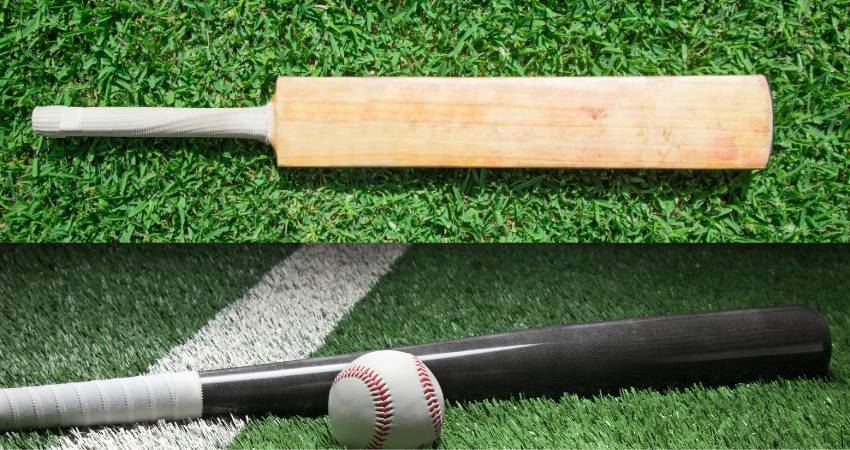
The first major difference between a baseball bat and a cricket bat is the shape. If you’ve never seen a cricket bat and someone just described the general rules of the game to you, you’d probably picture a cricketer swinging something that looks like a baseball bat. In reality, the shapes are worlds apart.
A baseball bat is long, narrow, and round. It has a rounded barrel at one end, which is what you use to hit the ball, and a noticeably thinner handle at the other end. That round, tapered profile is built to help you swing through the air efficiently.

A cricket bat, on the other hand, isn’t aerodynamic in the same way. It has two distinct sides: the front and the back. The front is flat, which is the part you use to strike the ball, and the back is ridged (or “spined”) to keep the bat light while still giving the blade enough mass to drive the ball.

The handle of a cricket bat is a lot more distinct than that of a baseball bat, and it’s noticeably thinner than the rest of the blade. It typically comes with a firmer grip than a baseball bat handle too, usually wrapped in rubber or cotton grip tape so the batter keeps full control through the swing.
2. Weight and Weight Distribution
Another major difference you’ll notice the moment you pick up the two bat types is their weight. Old-school baseball bats used to run heavier, sometimes 2 to 3 pounds, but the average adult wood or metal baseball bat these days weighs somewhere between 33 and 36 ounces (a little over 2 pounds).
Cricket bats sit noticeably heavier. A typical adult cricket bat weighs roughly 2.7 to 3.2 pounds, which is closer to those old-school baseball bats than anything you’d find in a modern lineup. That raw weight isn’t the only difference, either.
Because of their shape, cricket bats have a top-heavy build. Most of the mass sits up in the blade, which is the part of the bat you use to strike the ball. This gives the batter a lot of control over the swing and lets them play a wide range of shots, from defensive blocks to full-power drives.
Baseball bats, by contrast, usually have a balanced swing weight, meaning the mass is distributed fairly evenly along the length of the bat. There are exceptions: end-loaded baseball bats, which pack extra weight near the barrel, are popular with power hitters who are willing to trade some bat speed for pop.
3. Bat Size
Another obvious difference between a cricket bat and a baseball bat is length. On average, a baseball bat runs between 37 and 40 inches, and you won’t find a legal one longer than 42 inches.
Cricket bats cap out shorter. Law 5 of the Laws of Cricket, the rule that governs bat specs, sets a hard limit of 38 inches (965mm) long and 4.25 inches (108mm) wide for the blade. Umpires can (and do) check bats with a physical gauge to confirm they pass through that opening.
While baseball bat size is measured almost entirely in inches, cricket bats are sold by a numbered sizing system tied to a player’s height, similar to how youth baseball bats are sized. Junior bats run from Size 0 (roughly ages 4 to 5) up through Size 6 (roughly ages 10 to 12). From there, players typically move into a Harrow bat (roughly ages 12 to 14) and then a full-size adult bat, either Short Handle (SH) or the slightly longer Long Handle (LH) for taller players.
I won’t pretend to be the expert on cricket bat fitting since it’s not my sport, but if you’re here for baseball, sizing works differently and comes down to your height, weight, and swing style rather than a fixed number scale. My guide to picking a youth baseball bat walks through how to land on the right length and drop weight for a young hitter.
4. Construction Material
While both MLB-legal baseball bats and cricket bats are made of wood, the species used to build them are completely different. Old-school baseball bats used to be made of hickory wood. These days, maple, birch, and ash are the standard woods for high-end wooden bats.
Cricket bats, on the other hand, are made from willow, specifically a variety of white willow called cricket bat willow (Salix alba var. caerulea), grown mainly in England and commonly marketed as “English willow.” It’s prized because it’s light, resists denting, and compresses slightly on impact instead of splintering. Budget and training bats are often made from Kashmir willow instead, a denser wood grown in northern India that’s tougher but heavier and doesn’t generate quite the same rebound off the blade.

Unlike cricket bats, baseball bats can also be made from aluminum alloy or carbon composite. Youth and Little League players generally skip wood entirely. Most of them play with an alloy or composite bat instead, and if you’re trying to decide between the two, I’ve laid out the tradeoffs in my wood vs. composite baseball bats breakdown.

Even in high school or college baseball, wood bats are rare. They’re mostly a professional-level thing. A casual or amateur player usually sticks to a high-end composite or alloy bat. Cricket players, on the other hand, use wooden bats at every level, from junior club cricket up through international test matches.
5. Hitting Power
Now that I’ve covered the more obvious differences, let’s get into something less visible: hitting power.
A cricket bat is bigger and has a larger hitting surface, so you’d assume it generates more power on contact. That’s not really how it plays out.

Metal and composite baseball bat barrels produce what’s called the trampoline effect. The thin, hollow wall of the barrel flexes and springs back on contact, adding extra energy to the ball on top of whatever the hitter generated with the swing. It’s the same reason leagues cap performance with standards like BBCOR, to keep that spring effect from getting out of hand.
Solid wood baseball bats, the kind used in the MLB, don’t really get this benefit since there’s no hollow barrel to flex. In that sense, a wood bat and a cricket bat are more alike than you’d think: both rely almost entirely on the hitter’s bat speed and technique rather than a springy barrel. Cricket bats do get a small amount of natural compression from the willow itself, but nothing close to what a metal or composite baseball bat produces. That’s a big part of why metal and composite bats are the highest-power option of the three.
6. Hitting Angle
Another difference that’s not as obvious as shape or size is hitting angle, meaning the range of angles you can actually connect with the ball at in each sport.

In baseball, the hitter is trying to connect with the ball as it crosses through the strike zone. The bat is built for bat speed and clean energy transfer, but the swing plane itself isn’t very versatile since you’re swinging through a fairly narrow, defined zone.
A cricket bat, thanks to its flat face and the batter’s stance, can be angled to send the ball almost anywhere around the field, including behind the batter with shots like the reverse sweep. That kind of 360-degree shot selection is something a rounded baseball bat simply isn’t designed for.
Which is Harder to Hit Cricket or Baseball?
Tough one to answer honestly. I’m a baseball player and coach, always have been. Hand me a cricket bat and ask me to hit a cricket ball, and I’d have a rougher time than I would stepping into a batter’s box.

But trying to stay objective here, both sports have genuinely hard elements. In baseball, the pitcher is firing the ball in at high velocity, and since the bat has a fairly small, round hitting surface, squaring it up consistently is difficult no matter how much you practice.
The tough part about facing a cricket ball is that the bowler bounces it off the pitch before it reaches the batter. That bounce lets bowlers put all kinds of spin and seam movement on the ball, which can be brutal to read. Being a good batter in cricket takes quick reflexes and a sharp eye for spotting the ball’s line off the bounce.
Bottom line: both sports demand serious skill and hours of practice, just along different difficulty curves.
Is a Cricket Bat a Better Weapon Than a Baseball Bat?
To be honest, I wouldn’t rely on either a cricket bat or a baseball bat for self-defense. But if it came down to it, like a break-in and the only thing within reach is a bat, I’d probably grab the baseball bat.
Cricket bats can look pretty intimidating as a weapon. The edges are firm, and the flat face works fine as a blunt striking surface. The tradeoff is that a cricket bat is heavier and more top-loaded, so it’s slower to swing and harder to control quickly.
A baseball bat lets you swing faster with less effort, and that speed translates to a nastier hit. Either way, obviously, don’t go swinging a bat at anyone unless it’s a genuine emergency.
Final Thoughts
As you can see, there are a lot of real differences between a cricket bat and a baseball bat, from the flat willow blade to the round wood or composite barrel, and everything in between. Even if you don’t know the first thing about cricket, you’ll spot the differences easily once you know baseball.
For what it’s worth, I hope this comparison between a baseball bat and a cricket bat helped you understand what actually separates the two. Cheers!

With 4 years of Division II experience, a .272 career batting average, .410 on-base percentage, and 7 home runs, I’m now in my fifth season. I’ve played baseball since age 3, alongside future MLB Draft picks, and I aim to pursue a career in baseball professionally, be it playing, coaching, or scouting.