
One of the biggest debates in the baseball community, among the hitters at least, is which baseball bat is the best. And no, I am not talking about any brand or specific model. The bigger question here is regarding its construction. Are wooden baseball bats better, or should you go for metal bats?
Baseball bats have come a long way since their initial conception. The journey began with wooden baseball bats, but these days, metal and composite bats dominate high school, college, and travel ball leagues. This begs the question, should you even go for a wooden baseball bat anymore?
Wooden baseball bats are not the same as metal bats, and that goes well beyond durability. The performance of a bat varies drastically based on its construction material, and on top of that, most leagues have specific certification rules (BBCOR, USSSA, USABat) that dictate exactly which bats you’re even allowed to swing. That’s what I want to break down today.
Here, I’ll give you an in-depth comparison between wood and metal baseball bats, including the current league rules for each, so you have a clearer picture of which bat you want for your next investment. Let’s get started.
Metal Vs Wood Baseball Bats- Key Differences
Baseball bats can feel entirely different depending on their construction material. There’s a certain air of coolness with wooden baseball bats, it’s the OG design, after all. Metal bats came into the scene much later, but they’ve earned their spot too thanks to how versatile they are.
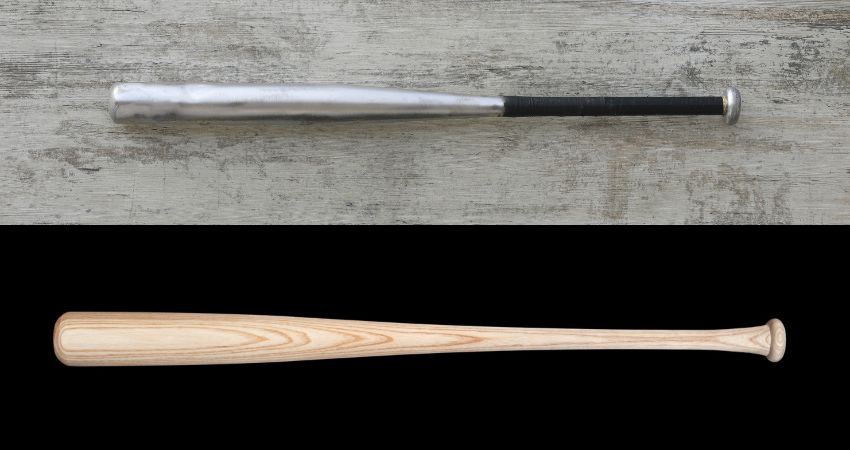
Durability
The first big difference between a metal and a wooden baseball bat is durability. If you watch pro baseball, I’m sure you’ve noticed how MLB hitters keep breaking their bats. That’s because they exclusively use wooden baseball bats.
A metal baseball bat doesn’t break as easily as one made of wood. Use it regularly and play rough with it, and it will eventually crack or dent. But it’ll be a good long while before you see any real signs of damage in a high-end aluminum baseball bat.
Contact Strength
Metal baseball bats get an edge over their wooden counterparts because of their superior contact strength. Thanks to the bigger sweet spot in a metal baseball bat, it has a greater trampoline effect. This, in turn, allows a player to send the ball further on perfect contact.
That isn’t to say wood bats are weak in terms of contact strength. Pro players hit home runs all the time, after all. But getting a wood bat to hit as hard as a metal bat takes more skill and practice to master. An amateur player might be able to send the ball flying with a metal baseball bat, but switch them to a wooden bat and they’ll find it harder to manage without practice.
Swing Speed
Strength isn’t everything in baseball. You might be able to transfer a lot of energy behind your swing to send the ball flying to the stands, but if you can’t swing your bat fast and with complete control, that’s a strike. Here again, metal baseball bats come out on top.
That might seem counterintuitive. Aren’t bats made of metal supposed to be heavier? Not usually. A “metal” baseball bat is typically made of aluminum, which is extremely lightweight, and metal bats are usually hollow on the inside.
Wooden bats, by comparison, are cut from a single, solid piece of wood, so there’s no hollow barrel to lighten the load. That’s why a wooden baseball bat feels heavier in your hands than a metal one, even at the same length.
Bat Response
Ask any hitter and they’ll tell you the response of a baseball bat has nothing to do with its weight or how hard you can swing it. It refers to the vibration you feel in your hands whenever you strike the ball. And as it turns out, the responsiveness of a wooden baseball bat is tough to match.
You’ll also feel your bat vibrate if it’s made of metal, but it’s a different kind of feel. Plenty of players say the vibration coming off a metal baseball bat feels too intense, and without a good batting glove, it can get uncomfortable to keep holding the bat after a mishit.
Affordability
Let’s be honest, if you’re shopping for a truly high-end baseball bat, it doesn’t matter whether you go metal or wood, it’s going to cost you quite a bit. But take a large sample of wooden and metal bats and compare their prices, and you’ll see that wood bats usually cost less upfront.
Then again, since metal bats last a lot longer, you won’t have to replace them as often, and that means money saved down the road. If you want a fuller picture of what actually eats into a bat’s lifespan, I broke that down separately in my post on how long baseball bats last.
League Rules and Bat Certification (BBCOR, USSSA, USABat)
Here’s the part a lot of comparisons like this one skip over, and it matters more than almost anything else on this list. You can’t just walk into a game with “a metal bat.” Nearly every level of organized baseball requires a specific certification stamp, and using the wrong one can get your bat pulled at the plate.
High school (NFHS) and college (NCAA) baseball both require a BBCOR-certified bat, meaning a max -3 drop weight (length in inches minus weight in ounces) capped at a .50 BBCOR performance rating. BBCOR was designed specifically to cap exit velocity so a metal bat’s batted-ball speed lines up closer to wood, which is why you’ll sometimes hear people call it “the closest thing to a wood bat.” If you want to see which BBCOR models actually hit well, I rounded up my picks in my guide to the best BBCOR bats for power hitters.
Most youth recreational leagues, including Little League Majors and below, run on the USABat standard instead. Competitive travel ball generally uses USSSA bats (look for the 1.15 BPF stamp), which allow drop weights from -5 down to around -12 depending on the division. One thing worth flagging if your player is moving into 14U travel ball: as of January 1, 2026, USSSA made -3 (BBCOR) the national standard at the 14U level, so national USSSA 14U events now call for a BBCOR-certified bat or a wood bat, not the drop-5 or drop-8 bats younger divisions use. Some local, state-level play may still allow lighter drops, so it’s worth double-checking with your specific league before buying.
Wood bats are exempt from BBCOR testing entirely, since a solid one-piece wood bat naturally performs within that limit without needing a certification stamp. That’s part of why wood is always a legal fallback no matter what level you’re playing at. For a full rundown of which certification applies to your kid’s league, my guide on how to choose a baseball bat goes deeper into it.
And at the very top, MLB and the vast majority of affiliated professional leagues require solid, one-piece wood bats. There’s no BBCOR loophole at that level. I’ll get into why a little further down.
Advantages of Wood Baseball Bats
As you can see, even though wood baseball bats seem inferior to metal bats on paper, they’re still the choice of professionals. So whatever you do, don’t overlook them entirely. Wooden baseball bats have real strengths you’ll miss out on by going with a metal bat, and if you’re shopping for one, I’ve rounded up my top picks in my guide to the best wood baseball bats.

Feels Better
When it comes to the feel of the bat, there’s no real competition. A wood baseball bat always has a better response when you make a successful swing. On contact with the ball, the vibration of a wooden baseball bat feels extremely satisfying.
Improves Skill and Strength
Driving the ball to the stands isn’t easy when you’re playing with a wooden baseball bat. You need to train harder and practice making perfect connections with your bat before you’re hitting any home runs with one. This forces you to become a better player and improves your swing accuracy and strength.
Safer Choice
Wooden baseball bats can shatter on impact, but it’s still a much safer option overall than a metal baseball bat performing outside its BBCOR limit would be. Because of the trampoline effect in a metal bat, if you drive the ball hard toward a defensive player, you can injure them by accident, which is exactly the risk BBCOR was created to control.
Advantages of Metal Baseball Bat
Metal baseball bats became an instant hit among enthusiasts and competitive players as soon as they hit the market, and there’s a good reason for it. When you look at what a metal baseball bat offers, its strengths become clear fast. If you want to browse current options across every certification, I put together a roundup of the best metal bats for baseball.

Larger Sweet Spot
The biggest advantage metal baseball bats bring to the table is a larger sweet spot compared to wood. Because of this, getting a solid connection on the baseball is much easier, even for a beginner. Just remember that in certified play, that extra pop is capped by whatever standard applies to your league (BBCOR, USSSA, or USABat), so it’s not an unlimited advantage the way it might feel in batting practice.
More Durable
While the biggest weakness of a wood baseball bat is that it shatters, you don’t have to worry about that with metal bats. A metal baseball bat lasts a lot longer than a wood one. Over time, metal bats may go dead, but even then, they’ll give you a couple of seasons’ worth of use easily.
Lightweight
Since metal baseball bats are lighter, you’re able to swing with more speed and more control. That means whenever you make a good connection with the baseball, you’re driving it out with real pace. Hitting home runs is easier with a metal baseball bat, all else being equal.
Are MLB Baseball Bats Wood or Metal?
When you’re talking about the big leagues, it doesn’t get bigger than the MLB. And let’s face it, we all want to get there. This is the stage where you can truly show off your skills in the sport. But daydreaming aside, I’m sure you’ve wondered what bats the pros actually use.

MLB is strict on the matter. Players in the MLB, and nearly every affiliated minor league level below it, are only allowed to use solid wood baseball bats in games. That’s why you see so many bats shatter over the course of a single broadcast. If you’re curious how that plays out one level down, I go into more detail in my post on whether college baseball uses metal bats.
There are a couple of reasons behind the rule. The first, and biggest, is safety for the players and the fans. Because of the trampoline effect that comes with a metal bat, a ball hit off metal can reach the pitcher, an infielder, or the stands with less warning than one hit off wood, and BBCOR’s whole purpose in amateur ball is to close that gap.
The second reason is tradition and record-keeping. MLB has tracked offensive statistics against wood bats for well over a century. Switching to metal, even a BBCOR-certified bat, would inflate batted-ball speed and distance across the board, making today’s numbers impossible to compare fairly against the game’s history. That’s a bigger deal in a league built on stat-keeping than it is in youth or amateur ball.
The only real drawback that comes with a wooden baseball bat at that level is that it shatters. Since MLB players are endorsed by different sporting brands, that isn’t a huge concern for them. Break one, and the company sends over a replacement.
Which is Better Wood or Metal Baseball Bat?
If you were paying attention, I’m sure you’ve noticed a case can be made for both types of baseball bats. There’s no universal right answer here, both wooden and metal baseball bats have their place in the sport. The bigger question is which one is right for your situation, and which certification your league actually requires.
If you want to go pro and hone your skill to match players at the biggest stage, I’d recommend getting familiar with a wooden baseball bat early. Just be prepared to spend more on replacements, since wood bats break more often than metal ones do.
If you’re playing high school, college, or competitive travel ball, you don’t get to choose freely anyway, your league’s certification rule decides that for you. A BBCOR-certified metal bat gives you excellent performance that’s tuned to play close to wood, and its durability makes the price tag worth it over a season or two.
Of course, there’s a third option. If you want a bit of both worlds, a composite bat is worth a look, and depending on your league, you may need one that’s specifically alloy or specifically composite. I’ve saved the battle between composite and wooden baseball bats and between alloy and composite baseball bats for those posts specifically, so check those out if you want the full picture.
I hope this in-depth look at the differences between wood and metal baseball bats, certification rules included, helped you understand what sets them apart. Good luck!

With 4 years of Division II experience, a .272 career batting average, .410 on-base percentage, and 7 home runs, I’m now in my fifth season. I’ve played baseball since age 3, alongside future MLB Draft picks, and I aim to pursue a career in baseball professionally, be it playing, coaching, or scouting.