
While both games get called softball, slowpitch and fastpitch are really two different sports once you look past the name. The rules are different, the pace is different, and so is the gear you’re expected to bring to the field.
I’m not here to break down every rule difference between the two games. What I want to talk about is the bats, because that’s where I get the most questions from readers showing up to a game with the wrong stick in their bag.
The key differences are in:
- Bat Shape
- Weight of the Bat
- Bat Length
- Cost
- Certification
A slowpitch softball bat is built to perform in that game specifically, and it won’t cut it in a game of fastpitch. In fact, officials won’t let you step up to the plate unless you’re carrying the right bat for the game you’re playing.
So what are the actual differences, and why should you care? If you want to play your best and stop guessing at the plate, you need to be equipped with the right gear.
That’s why I’m going to walk through the key differences between slowpitch and fastpitch softball bats, plus leave you my current recommendation for each bat type.
Differences Between Slowpitch and Fastpitch Softball Bats
Softball bats come in a wide range of designs. But when you put a slowpitch softball bat next to a fastpitch softball bat, some pretty major differences jump out. Size, shape, weight, certification, and cost are all different between the two.
Let me give you a quick rundown of the major variables.
1. Bat Shape
The first difference you’ll notice at a glance is the shape. Fastpitch bats are built leaner through the barrel so you can whip the bat through the zone fast. Slowpitch bats carry a thicker, rounder barrel profile that helps you transfer more mass into a pitch that’s already dropping in slow.
Here’s the part that trips a lot of people up though. Fastpitch and slowpitch bats are both built to the same 2 1/4 inch barrel diameter under USA Softball and USSSA rules, so that “bigger barrel” feeling isn’t really about width. It comes down to barrel length instead. Slowpitch barrels are commonly sold in 12, 13, or 14 inch options, and that length, combined with the wall construction, is what actually changes how thick and forgiving the barrel feels in your hands.
2. Weight of the Bat
Slowpitch softball bats, because of that thicker barrel, run heavier than fastpitch bats. Expect something in the 26 to 30 ounce range, which works out to about 737 to 850 grams. Most slowpitch models are sold in 26, 27, 28, and 30 ounce builds.
Fastpitch softball bats are noticeably lighter, generally 15 to 26 ounces, or 425 to 737 grams. Fastpitch hitters want that lighter swing weight because they need to get the bat through the zone fast to catch up to a much quicker pitch.
3. Bat Length
Length is where people usually get confused, so let me clear it up. Both slowpitch and fastpitch bats are capped at a legal 34 inches. The real difference shows up in the drop weight, which is just the bat’s length in inches minus its weight in ounces.
Slowpitch hitters tend to run a small drop, somewhere around -4 to -6 for power hitters who want maximum mass behind the ball, up to -7 to -9 for contact hitters who want a bit more bat speed.
Fastpitch hitters go the other direction. A -10 drop is the most popular pick across the sport, younger or smaller players often go as high as -11 or -12 for a lighter swing, and stronger college-level power hitters can handle a -9. The bigger the drop number, the lighter the bat feels relative to its length.
4. Cost
Slowpitch bats are still the more affordable side of the aisle. A great USSSA or USA/ASA certified slowpitch bat usually lands in the $250 to $320 range, and you rarely need to spend more than that to get tournament-level performance.
Fastpitch has gotten pricier in recent years. Today’s top composite bats from brands like Easton and Louisville Slugger regularly run $400 to $500. The good news is budget-friendly alloy options are still out there for well under $150, so you’re not forced to spend big if you’re just starting out or buying for a growing kid.
5. Certification Stamp
There’s a fifth difference that doesn’t get talked about enough: the certification stamp on the barrel.
Both fastpitch and slowpitch bats need to carry the right stamp for whatever league you’re playing in, whether that’s USA Softball (the body formerly known as ASA), USSSA, NSA, or ISA. Each association certifies bats against its own performance standard, so a bat that’s legal in one league isn’t automatically legal in another.
USA/ASA certified fastpitch bats, for example, are tested against a 98 mph batted ball speed limit. Show up with an uncertified or wrong-stamp bat at a sanctioned game and an umpire can pull it before you get a single swing in. If you want the full breakdown of how the two biggest stamps compare, I’ve covered it in USSSA Vs ASA Softball Bats.
Can You Use a Slowpitch Softball Bat in Fastpitch?
While it’s not technically illegal in most casual settings, I’d strongly advise against using a slowpitch bat in a fastpitch game. Fastpitch pitchers bring real velocity. High schoolers commonly sit in the mid 50s to mid 60s mph, college pitchers run from the high 50s into the low 70s, and the fastest pitch ever recorded in NCAA softball hit 78.2 mph, thrown by Tennessee’s Karlyn Pickens. You need to react fast, and that’s not what a slowpitch bat is built for.
The bigger size and heavier swing weight of a slowpitch bat becomes a real roadblock here. You’ll struggle to get the bat through the zone in time, and squaring up a pitch in the 60 to 70 mph range with a bat built for a lobbed pitch just isn’t realistic. If you’re playing seriously, stick with a properly certified fastpitch bat.
Can You Use a Fastpitch Softball Bat in Slowpitch?
Going the other way isn’t a great idea either. Slowpitch pitches are thrown underhand with an arc. USA Softball rules require the pitch to peak between 6 and 12 feet before it comes back down, so you’ve got plenty of time to load up your swing.
Since fastpitch bats are so much lighter, you can still make contact without much trouble. But you’ll leave a lot of pop on the table. Slowpitch bats are built with a heavier, thicker barrel specifically to punish a ball that’s dropping in slow, and a fastpitch bat just doesn’t carry the mass to do that as well.
If you want a real recommendation for each side, here’s what I’d grab.
Recommendation: DeMarini Mercy 2026 USA/ASA Slowpitch Softball Bat
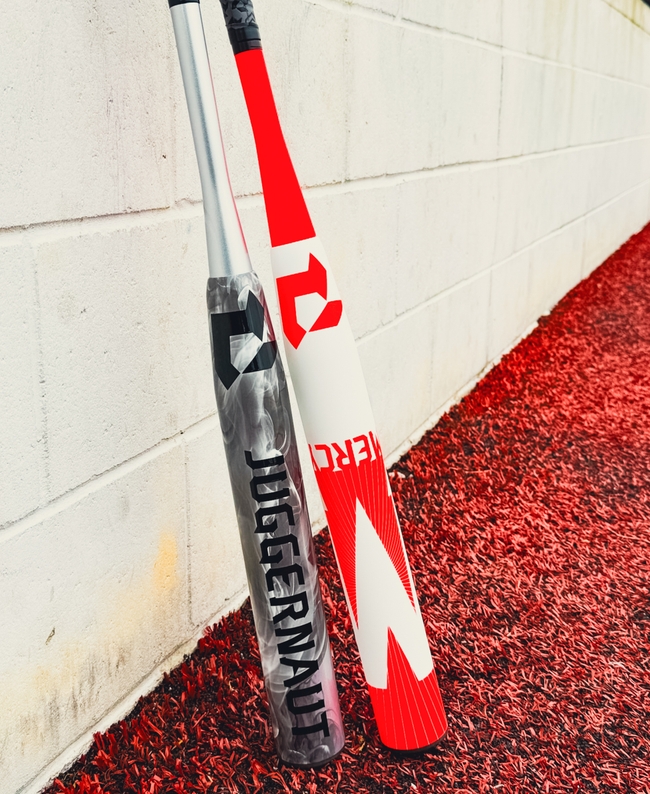
For slowpitch, I’m pointing you to the 2026 DeMarini Mercy. It’s a two-piece composite bat with a stacked composite barrel and a 13 inch endloaded design, USA/ASA certified, and it runs right around $300, squarely in that sweet spot I mentioned above.
The endloaded swing weight puts more mass out toward the barrel, which is exactly what you want if your game is about driving the ball deep rather than slapping and running. DeMarini has built the Mercy line for years, and the 2026 version carries the same reputation for a forgiving sweet spot and a stiff, responsive barrel feel.
If you’d rather go balanced instead of endloaded, current bats like the Miken Freak Primo and the Worth Krecher are also worth a swing in that same $300 to $350 range. But ounce for ounce, the Mercy is where I’d start.
Recommendation: Rawlings | Mantra | Fastpitch Softball Bat Series

Whenever someone asks me about the best fastpitch bat out there, my mind jumps to the Rawlings Mantra. The 2026 version keeps the same two-piece composite design, with an In/Tense Carbon Composite barrel and a Three-Step Inner Barrel that’s built to deliver consistent swing speed across the whole hitting surface.
It’s an All Association certified bat, meaning it’s built to be legal across USA Softball, USSSA, and the other major governing bodies, so you’re not stuck buying a different bat for every league. The 2026 Mantra also picked up an F2 Collar connection at the handle-to-barrel junction, which cuts down on vibration and handle drag so more of that energy makes it into the ball. It’s available in 29 to 34 inch lengths with -9, -10, and -11 drop options (heads up, the -11 isn’t approved for college play).
MSRP sits right around $400, though it’s worth shopping around since it dips lower during sales. It’s not the cheapest bat on the shelf, but it delivers. If you want more fastpitch options beyond the Mantra, I’ve rounded up more picks in 7 Best Fastpitch Softball Bats for Power Hitters.
The Bottom Line
The truth is, you probably won’t get arrested for showing up with the wrong bat, but you will be leaving performance on the table. Use a fastpitch bat for fastpitch games and a slowpitch bat for slowpitch games. It’s really that simple.
Now that you know what actually separates these two bat types, from barrel construction to drop weight to the certification stamp, you’re in a much better spot to pick the right one for your game. Good luck out there.

With 4 years of Division II experience, a .272 career batting average, .410 on-base percentage, and 7 home runs, I’m now in my fifth season. I’ve played baseball since age 3, alongside future MLB Draft picks, and I aim to pursue a career in baseball professionally, be it playing, coaching, or scouting.