
A bat has to feel like an extension of your arm. There are few worse feelings than swinging gracefully through the zone and not hearing that satisfying pop, or worse, feeling the bat drag through your hands like it’s fighting you.
I had a lot of those days early on, and most of it traced back to not understanding bat drop. I had no clue what that number on the barrel actually meant, so I’d just grab whatever my coach pointed at and hope for the best.
Simply put, bat drop is bat length minus bat weight. Subtract the weight (in ounces) from the length (in inches) and you get the drop. Understanding that number is one of the fastest ways to pick a softball bat that actually fits your swing instead of guessing.
Let me walk you through what drop weight actually means, how to figure out the right one for your game, and a few current bats worth a look at the three most common fastpitch drops.
What Does Drop Weight Mean on a Softball Bat?
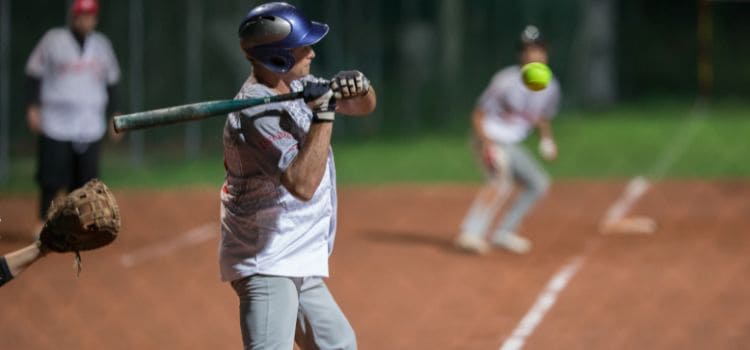
Drop weight, or bat drop, is the relationship between a bat’s length and its weight. You calculate it by subtracting the bat’s weight in ounces from its length in inches.
- Bat length (in.) – Bat weight (oz.) = Bat drop
For example, a 33-inch bat that weighs 22 ounces has a drop of -11, or “drop 11.” Beginners and younger players usually land somewhere around -11 to -13. As players get older and stronger, the drop typically gets lower (closer to zero), since the bat gets heavier relative to its length.
Note: A lower-magnitude drop number means a heavier bat. A -5 bat is heavier than a -10 bat, even though -5 looks like the “smaller” number.
How to Determine the Right Drop for Your Softball Bat
Drop comes down to two things: the length of the bat and the weight of the bat. Here’s how I think through both.
Length
Length is the distance from the knob to the end cap. Softball bats generally run from 28 to 34 inches. A longer bat gives you more plate coverage, especially on pitches away from you.
But longer isn’t automatically better. A longer bat is a heavier bat, and if you can’t control that extra length, your bat speed and timing both suffer. The right length comes down to your swing, your stance relative to the plate, and how much plate coverage you actually need.
Weight and League Rules
Weight is measured in ounces, and the right weight for you depends on your league’s rules and your own preference as a hitter. Every softball association sets its own limits on allowable drop, so check your league’s approved bat list before you buy, not after.
Newer or lighter-framed players usually prefer a lighter bat (a bigger negative drop number) for more control, even though it sacrifices some power. Stronger, more experienced hitters often move toward a heavier bat (a smaller negative drop number) to drive the ball harder. For fastpitch specifically, drop typically runs between -8 and -13, depending on age and strength.
What Does Drop 10 Mean on a Softball Bat?
A drop 10 bat has a length-to-weight ratio of -10. So a 32-inch bat that weighs 22 ounces is a drop 10.
What’s the Difference Between Drop 10 and Drop 11 Softball Bats?
A drop 10 bat is heavier than a drop 11 bat of the same length, since less weight was subtracted to get there. That extra mass on a drop 10 generally means more raw power on contact, while a drop 11 swings lighter and faster, which some hitters translate into better bat control and quicker reaction time on a rising fastpitch. Neither is objectively “better.” It’s a tradeoff between control and power that depends on your swing.
What Drop Softball Bat Should I Get?
Nail down length first, then worry about drop. Here are three ways to check if a bat’s length actually fits you.
Method 1
Place the knob in the middle of your chest and extend the bat along your arm. If you can wrap your fingertips around the end cap, the length is right for you.
Method 2
Stand the bat on the ground and rest your hand on top of the knob. If it’s the right size, your palm should sit comfortably flat on the top of the knob without you having to hunch or reach down.
Method 3
Similar to Method 1: place the knob perpendicular to your sternum and extend your arm straight out. If your hand reaches the barrel comfortably, that’s a good length.
Once you’ve got length figured out, here’s a rough drop range by age group to use as a starting point, not a hard rule. Always check what your specific league allows.
- Ages 4-6: Drop -11 to -13
- Ages 7-11: Drop -10 to -12
- Ages 12-14: Drop -10 to -11
- Ages 15 and up: Drop -8 to -10
Leagues and Certifications
A handful of governing bodies set the rules for what bats are legal in sanctioned play, including drop weight limits: the United States Specialty Sports Association (USSSA), USA Softball (formerly known as ASA), the National Softball Association (NSA), the Independent Softball Association (ISA), and the World Baseball Softball Confederation (WBSC). Each sets its own standards, and manufacturers stamp an approved bat with the certification marks it’s cleared for.
Standards and approved-bat lists change over time, and USSSA and USA Softball don’t test bats the same way, so a bat legal in one association isn’t automatically legal in the other. I break down exactly how those two certifications differ in my USSSA vs. ASA (USA Softball) softball bats comparison. Always confirm with your coach or league official before buying, since the sticker on the barrel is the source of truth, not what a website says.
If you’re also playing (or coaching) baseball and want to know how bat drop works on that side, I cover it separately in what a baseball bat drop is, since the typical ranges and BBCOR rules are different from fastpitch softball. And if you’re not sure which sport’s bat rules even apply to you, my softball bat vs. baseball bat breakdown covers the core differences.
A Quick Recommendation of -9, -10, and -11 Softball Bats
If all this drop math has your head spinning, take a breath, it’s simpler in practice than it sounds. Here are three bats I’d point you toward at the three most common fastpitch drops, one of which I’ve written about in more depth elsewhere on the site.
1. Rawlings Mantra Fastpitch Softball Bat (Drop 9)

The Rawlings Mantra is still one of my go-to picks when a player is ready to move up to a premium fastpitch bat. It’s a two-piece composite build, with a barrel made from layered carbon fiber that keeps sting down on mishits while staying light in your hands.
Rawlings uses a multi-step inner barrel that spreads weight evenly across the barrel length, and the outer layer is noticeably thinner, which boosts the trampoline effect and gives you a genuinely satisfying pop on contact. The F2 collar system between the barrel and handle cuts down on drag and vibration, and the bat has a lizard skin grip for tack.
The Mantra line comes in -9, -10, and -11, and it’s certified for USSSA, NSA, USA Softball, ISF, and ISA play, so it clears most rec and travel leagues. It sits toward the premium end of the price range, so I’d treat it as an investment bat for a player who has outgrown entry-level gear rather than a first bat.
2. Louisville Slugger LXT Fastpitch Softball Bat (Drop 10)

The current LXT is a two-piece composite bat built around Louisville Slugger’s VCX3 Connection System, an elastomeric connector that cuts vibration at contact while still giving you a solid, unmistakable feel through the barrel. That’s a change from older LXT generations, which used a three-piece design with the earlier VCX2 connector, so don’t be surprised if you see conflicting specs on older reviews.
The composite barrel is built for a larger sweet spot, and the COPA Performance End Cap pushes that sweet spot out even further. It’s available in drops -8 through -11 and carries certification from ISA, NSA, USA Softball, and USSSA. I put it head-to-head against its closest rival in my Easton vs. Louisville Slugger softball bats comparison if you want the full breakdown.
3. Easton Ghost Advanced Fastpitch Softball Bat (Drop 11)

Quick correction from an older version of this post: the Ghost Advanced is a composite bat, not aluminum. It runs on Easton’s Double Barrel 3 platform, pairing a lightweight inner barrel with Easton’s lowest-compression outer barrel yet, built from their Sonic Comp Max composite. That combination lets the barrel flex more on contact, which is a big part of why it’s known as such a hot bat right out of the wrapper.
The two pieces connect through Easton’s ConneXion Evolution system, and the Power Boost Soft Knob gives you more leverage while cutting vibration in your bottom hand. It’s available in drop -8 through -11 with a 2 1/4-inch barrel, and it’s certified for USA Softball, USSSA (fastpitch only), NSA, ISA, and WBSC play. I go deeper on this exact bat, including how it compares for pure exit velocity, in what softball bat has the most pop.
Final Words
Getting the right gear matters in any sport, and a bat that’s the wrong drop for your size and strength will fight you all season no matter how clean your mechanics are. Any of the three bats above are solid picks at their respective drops, but the right one for you always comes down to your own length, strength, and league rules.
Whenever you’re confused about drop, just come back to the equation:
- Bat length – Bat weight = Bat drop
Once that’s locked in, you shouldn’t have any trouble picking the right bat. If your current bat feels like it’s lost its pop even though the drop is right, that’s usually a different problem, worth checking my guides on how to tell if a softball bat is dead and how long a softball bat actually lasts. Hope this helped. Have a great game!

With 4 years of Division II experience, a .272 career batting average, .410 on-base percentage, and 7 home runs, I’m now in my fifth season. I’ve played baseball since age 3, alongside future MLB Draft picks, and I aim to pursue a career in baseball professionally, be it playing, coaching, or scouting.