
I spent most of my childhood on ball fields. Even now, I think of a weekend as wasted unless I get out there with a couple of friends for a game of baseball or softball. Honestly, once I’m playing, it doesn’t matter much to me which one it is.
But over the years I’ve watched a lot of players grab a baseball catcher’s mitt because that’s what’s in the bag, even when the game on deck is fastpitch softball.
It’s not ideal, but it can work if a few conditions are met. With the right catcher’s mitt, you can get through a fastpitch softball game without too much trouble.
In this article, I’ll walk through what actually separates a baseball catcher’s mitt from a fastpitch softball catcher’s mitt, whether the rulebook cares, and what I’d recommend if you only want to own one mitt for both games.

Are Baseball Gloves and Softball Gloves Actually the Same Thing?
I’ve seen people swap baseball and softball gloves back and forth all the time in casual games. And in a backyard game, sure, nobody’s going to stop you.
But if you look at how these gloves are actually built, they’re not interchangeable the way people treat them. I go into this in more detail in my baseball gloves vs softball gloves breakdown, but the short version is that baseball gloves and mitts tend to run smaller than their softball counterparts because they’re built around a smaller ball.
Even a baseball catcher’s mitt, which is already bigger than a standard baseball glove, is usually undersized for a fastpitch softball. That’s a mitt problem, not a glove problem specifically. If you’ve ever wondered where a mitt fits into the mitt-versus-glove conversation, I broke that down separately in baseball mitt vs glove and in do catchers use a glove or a mitt.
Because of that size gap, catching or throwing a softball out of a baseball mitt is going to feel cramped. You’ll be fighting the pocket instead of trusting it.
Remember too that a baseball glove and a baseball catcher’s mitt aren’t the same tool. A catcher’s mitt, as the name says, is built for one job: catching. So let’s get into what actually separates a baseball catcher’s mitt from one made for fastpitch softball.
The Differences Between a Baseball Catcher’s Mitt and a Softball Catcher’s Mitt
Size
Mitt sizes are measured in circumference, not length, and that’s where the two sports really start to diverge. Most adult baseball catcher’s mitts run somewhere around 32.5 to 34.5 inches. Fastpitch softball catcher’s mitts run a bit larger, typically 33 to 35 inches, to give a deeper, wider home for a softball. Youth sizes on both sides run smaller, so always check the size chart for the player’s age and level before buying.
Pocket Depth
A regulation baseball is smaller than a fastpitch softball, and softball really is noticeably bigger once you hold both side by side. That size difference shows up directly in the pocket. Baseball catcher’s mitts have a shallower, more tapered pocket built for a smaller ball. Softball catcher’s mitts go deeper and wider, with thinner side walls, so a bigger ball can actually settle into the pocket instead of bouncing off the heel.
Use a baseball mitt for softball and the ball never fully seats in the pocket. That’s when you start fumbling clean catches, which is the last thing you want behind the plate.
Padding
Baseball catcher’s mitts carry noticeably more padding than softball mitts. Baseball pitches, especially at the high school level and up, come in harder, so that extra cushioning in the palm matters. Fastpitch softball pitchers still bring real heat from a much shorter distance, but softball catchers generally want a bit more feel and mobility out of their mitt without giving up too much protection.
Webbing
Both baseball and fastpitch catcher’s mitts almost always use a closed, one-piece web rather than an open web pattern. That’s on purpose. A closed web hides the ball and keeps the catcher’s grip from tipping off the batter or the runner on second. The difference between sports comes down to how that web is sized and shaped to match the ball, not whether it’s open or closed.
Fit
Fit preferences differ too, even if this one varies more by individual player. Fastpitch softball players tend to like a snugger fit than baseball players do. Because of that, most fastpitch catcher’s mitts come with a Velcro or lace-adjustable wrist closure so the player can dial in a custom fit, which also happens to help players with smaller hands get a secure fit. Baseball catcher’s mitts more often skip the Velcro strap in favor of a simpler back design.
Does the Rulebook Actually Care Which Mitt You Use?
Sort of, but probably not in the way you’d expect. MLB’s official rule (3.04) caps a legal catcher’s mitt at 38 inches in circumference and 15.5 inches from top to bottom, and it has to be a true catcher’s mitt, not a fielder’s glove or a first baseman’s mitt worn behind the plate. NFHS, NCAA, USSSA, and USA Softball all define a legal catcher’s mitt in their own rulebooks in a similar way, by circumference and by requiring a mitt built for the position rather than a repurposed fielder’s glove.
Here’s the thing though: every mitt sold at retail, baseball or softball, falls well inside those circumference limits. So size legality almost never becomes the actual issue. What does come up at equipment checks in travel ball and high school ball is whether the mitt is a genuine catcher’s mitt at all, and in some leagues, whether it’s the sport-appropriate mitt. If you’re playing in an organized league with equipment checks, it’s worth confirming with your league or umpire before you show up with a baseball mitt on a softball diamond. For a casual rec league or a backyard game, nobody’s measuring your mitt.
So, Can You Use a Baseball Catcher’s Mitt for Fastpitch Softball?
It’s not ideal, but yes, you can use a baseball catcher’s mitt for fastpitch softball. Since a catcher’s mitt already runs bigger than a standard baseball glove, you can usually get away with it for casual games. I still wouldn’t recommend it for anything competitive.
What I’d actually recommend is finding a mitt built to serve both sports well. That means paying attention to the size, the pocket depth, and the overall fit rather than grabbing whatever mitt happens to be closest to the door.
Two Catcher’s Mitts Worth Using for Both Baseball and Softball
Before I get into the options, I want to repeat myself. A baseball catcher’s mitt is not the right tool for softball if you’re playing anything serious. But as a casual player who doesn’t want to buy two mitts, here are the two I’d point you toward.
1. Rawlings Player Preferred Catcher’s Mitt

When it comes to sub-100-dollar gloves for softball and baseball, the Rawlings Player Preferred has been my go-to whenever I’m catching a casual game. It’s a Rawlings, so it needs very little break-in out of the box, though I’d still work it in properly before game day if you can.
This is officially a baseball catcher’s mitt, not one Rawlings markets for softball, but it’s a genuine crossover pick for casual players who don’t want to buy separate gear for each sport. Rawlings clearly built it for players who aren’t going to spend real money on two setups.
It comes in a 33 inch size with Rawlings’ Zero Shock Palm Pad for impact protection, a conventional back for a secure, comfortable fit, and a Velcro wrist strap so you can adjust the fit yourself. The shell is genuine buffalo leather, including the laces, so it holds up over time.
The one-piece solid web keeps the ball centered in the pocket, which helps on the baseball side. On the softball side, expect it to feel a little small and shallow compared to a true fastpitch mitt, since the pocket just wasn’t built around a softball. For the price and the versatility, that’s a tradeoff I’m willing to live with for casual play.
2. Rawlings Liberty Advanced Fastpitch Catcher’s Mitt
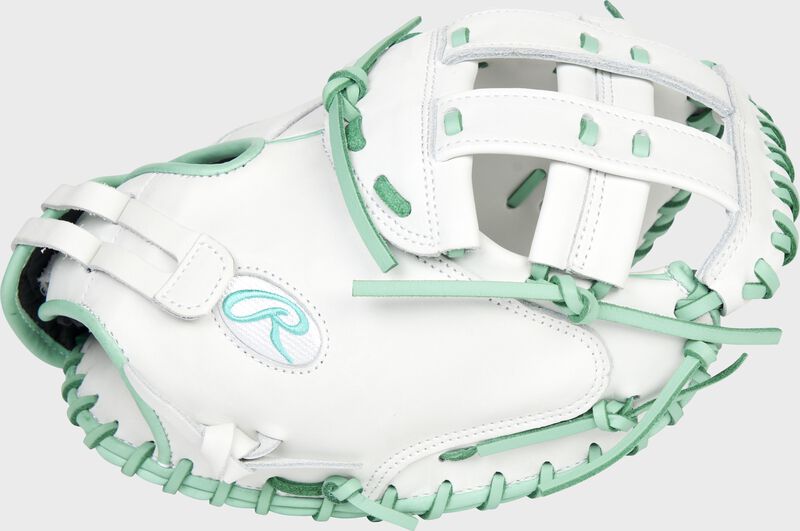
For serious fastpitch softball catchers, the Player Preferred isn’t the play. It’s versatile, sure, but a mitt built specifically for softball will beat a crossover mitt every time. That’s why you won’t see competitive travel or high school catchers using a baseball mitt behind the plate.
For that level of player, the Rawlings Liberty Advanced is the one I’d point you to. It’s a legitimate step up, and I mean that in the sense that it’s built for the position, not just adapted to it.
It comes in a 34 inch size, sized for catching fastpitch softball without wrestling the ball into a too-shallow pocket. It also comes in a 33 inch size if you want something a bit more compact. You get Poron XRD padding across the palm for real impact protection against hard pitches, a Pro H web that helps frame and secure the ball, and a full-grain leather shell that’s built to take a beating over a full season.
One note on buying it: Rawlings sells this model directly and it’s currently listed as out of stock on their own site as of this writing, so check availability at a retailer like Dick’s Sporting Goods, BaseballMonkey, or Diamond Sport Gear if Rawlings.com shows it unavailable when you look.
Quick Answers
Can I use a first baseman’s mitt to catch softball instead?
No. A first baseman’s mitt has a shallower, scoop-style pocket built for digging low throws out of the dirt, not for absorbing a fastpitch delivery at close range. Most rulebooks, including MLB’s, require catchers to use a mitt built and designated for the position.
What size catcher’s mitt does a 12U or 14U fastpitch catcher need?
It depends on hand size and the manufacturer’s youth chart more than age alone, so I’d always try the mitt on before buying. As a general starting point, younger fastpitch catchers often land in the 31 to 32.5 inch range before moving up to a full 33 to 35 inch adult mitt in their mid-teens. I go through this in more detail in how do you size a fastpitch softball glove.
Do Wilson, Mizuno, and All-Star make fastpitch catcher’s mitts too?
Yes. Rawlings isn’t the only brand building fastpitch-specific catcher’s mitts right now. Wilson, Mizuno, and All-Star all currently sell dedicated fastpitch softball catcher’s mitts, so it’s worth trying a few brands on before you buy if a specialty shop near you carries them. Fit varies more by brand than most players expect.
Parting Shots
If I’m being honest, I’d always reach for a fastpitch-specific catcher’s mitt when I’m playing this game for real. But I get the urge to skip a second purchase when you’re only playing casually.
So if you’re going to use a baseball catcher’s mitt for softball, at least invest in a decent one. The two options above will give you solid performance and hold up for a long time. Cheers.

With 4 years of Division II experience, a .272 career batting average, .410 on-base percentage, and 7 home runs, I’m now in my fifth season. I’ve played baseball since age 3, alongside future MLB Draft picks, and I aim to pursue a career in baseball professionally, be it playing, coaching, or scouting.