
Baseball and softball share a lot of the same DNA, but the two games are not the same sport wearing a different jersey. The rules overlap in places, sure. The gear does not. If you have ever picked up a baseball bat and a softball bat side by side, you already know something is different, even if you cannot quite put your finger on what.
Beyond the fact that using the wrong bat can get you an earful from the umpire, swinging a baseball bat in a softball game (or the other way around) just will not perform the way you expect. You want the right tool for the job, plain and simple.
At a glance, the two bats look like cousins. Look closer, though, and the differences between a softball bat and a baseball bat start stacking up fast.
So let’s settle the softball bat vs baseball bat question for good. I’ll walk you through every real difference, length, weight, barrel diameter, handle, and certification, so you know exactly why the right bat matters and how it changes your performance on the field.
Softball Bat vs Baseball Bat (Summary)
Here’s a quick chart to give you the short version before we dig into the details.
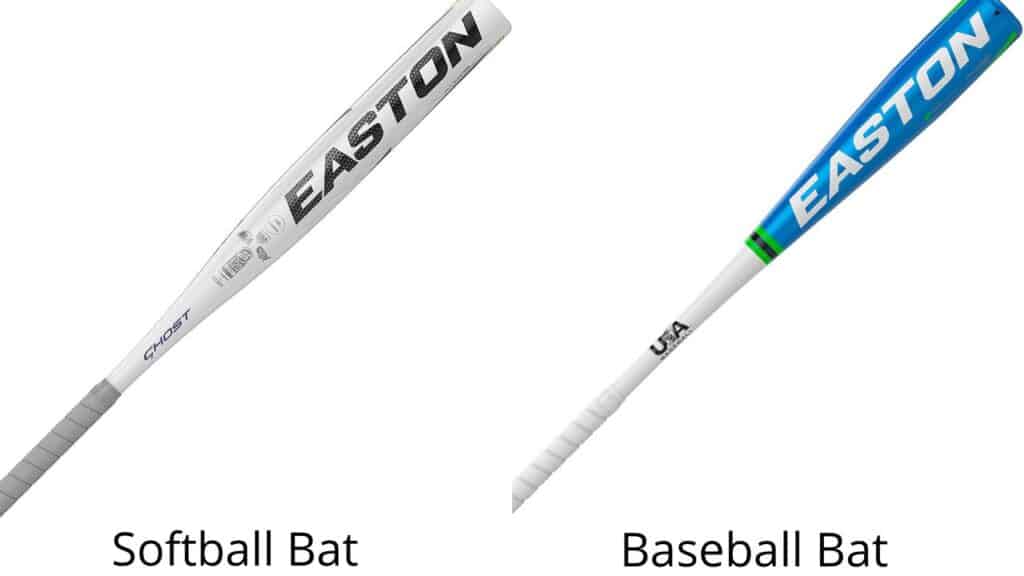
| Features | Baseball | Fastpitch Softball | Slowpitch Softball |
| Length | 34 inches max | 34 inches max | 34 inches max |
| Weight | Follows -3 rule (BBCOR) | 23-28 oz | 26-30 oz |
| Barrel Diameter | 2-5/8″ | 2-1/4″ | 2-1/4″ |
| Handle Design | Large | Small | Large |
| Certification | BBCOR, USA Baseball, USSSA | USSSA, USA Softball | USSSA, USA Softball |
What are the Differences Between Baseball and Softball Bats?
I’ll say it again because it’s worth repeating: softball bats and baseball bats are built for two different jobs. Length, weight, barrel diameter, handle, certification, even price, all of it varies. That’s not an accident. It’s by design, because the two sports throw completely different challenges at a hitter.
Just because you own the best softball bat money can buy does not mean it will do you any good in a baseball game. It will feel fantastic in softball, but baseball needs a bat built to handle a smaller, harder ball under a completely different certification standard.
Let me walk you through every real difference between the two.
1. Length of the Bat

Here’s something that’s changed in the last few years: the length gap between baseball and softball bats has basically closed at the top end. Today’s adult BBCOR baseball bats commonly run up to 34 inches, the same ceiling softball bats have always had. So length alone is not the giveaway it used to be.
What hasn’t changed is why hitters in each sport gravitate toward different setups. In baseball, the pitcher’s mound sits further away, and the pitcher throws from a raised position. That gives the batter a little more time to read the pitch.
In softball, the pitcher and batter stand at the same level, and the circle sits a lot closer to the plate. Less time to react means softball hitters often lean on a longer, lighter bat that lets them get the barrel out front and still catch the sweet spot.
Baseball pitches also tend to come in hotter than most softball pitches, though fastpitch windmill pitching closes that gap more than people expect. So baseball hitters typically want a bat on the lighter, quicker side of the -3 rule so they can still get the barrel through the zone in time.
Bottom line: it’s less about who gets the longer bat these days and more about weight, balance, and how fast you need to swing the softball bat or baseball bat through the zone to catch up to the pitch.
2. Weight of the Bat
Weight is where baseball and softball bats really part ways. High school and adult baseball leagues use what’s called the -3 drop rule, meaning the bat’s weight in ounces can’t be more than 3 less than its length in inches. A 33-inch bat, for example, has to weigh at least 30 ounces.
That rule exists for a safety reason. An extremely light bat relative to its length lets a hitter generate dangerous bat speed, and that raises exit velocity to a point where it’s no longer safe for the pitcher and infielders.
Softball doesn’t use the -3 rule at all. Instead, weight comes down to whether you’re playing fastpitch or slowpitch and what your league’s bat drop allows.
Slowpitch hitters usually go heavier since the pitch comes in lobbed and slow, and a heavier bat means more power behind contact. Typical slowpitch bats run about 26 to 30 ounces.
Fastpitch hitters go the other way and want something lighter so they can generate bat speed against a pitch that’s coming in fast from close range. Most fastpitch bats sit around 23 to 28 ounces. If you want the full rundown, I’ve got a whole article comparing slowpitch and fastpitch softball bats.
3. Barrel Diameter
Barrel diameter is one of the easiest ways to tell the two apart just by looking. Set a baseball bat next to any high-end fastpitch softball bat, and you’ll immediately notice the baseball bat’s barrel is fatter.
That’s a direct response to ball size. Baseballs are smaller than softballs, so a wider barrel gives the hitter more forgiveness and a better shot at squaring the ball up.
Softball bats stick to a narrower barrel because the ball itself is already bigger, so hitters would rather have a thinner barrel that’s quicker to whip through the zone.
The one exception is slowpitch. Since the pitch is lobbed in slow, slowpitch hitters can afford the extra weight and a barrel built for power without worrying about catching up to velocity.
By the numbers: adult baseball bats run a max barrel of 2-5/8 inches, while softball bats, fastpitch and slowpitch alike, are capped at 2-1/4 inches under both USSSA and USA Softball rules.
4. Handle Design

Look closely at the handle of a baseball bat next to a softball bat, and you’ll notice they’re built differently for good reason.
Baseball is still played mostly by hitters with larger hands, so manufacturers build in a slightly thicker handle for a secure grip.
Softball, fastpitch especially, skews toward hitters who want to whip the barrel from shoulder to hip as fast as possible. A thinner, leaner handle helps with that quick load-and-release swing.
Ball size plays a role too. A smaller baseball lets manufacturers pair a thicker handle with a slightly bigger barrel without throwing off the swing weight. Since softballs are bigger to begin with, the handle can stay thinner without sacrificing bat speed.
5. Bat Certifications: BBCOR, USSSA, and USA Bat vs. USA Softball
This is the difference that trips up the most people, and it’s the one that actually gets you turned away from a game if you get it wrong.
Baseball bats get certified under one of three standards. BBCOR covers high school and college play, caps the barrel at 2-5/8 inches, holds bats to the -3 drop, and limits the “trampoline effect” off the barrel to a strict .50 BBCOR rating. USA Baseball (USA Bat) covers most youth rec and travel leagues through 14U and drops the -3 restriction, allowing drops as steep as -13. USSSA is the other common youth and travel standard, running a 1.15 BPF rating with drops from -5 down to -13.
Softball runs on its own standards. USA Softball is the modern name for what used to be called ASA (the Amateur Softball Association rebranded back in 2016). Bats already stamped ASA are still legal today, that part never changed, just the name on new stamps. USSSA is the other major softball certification, and it runs hotter than USA Softball thanks to a higher 1.20 BPF rating, which is why USSSA-only bats aren’t allowed in most school-sanctioned games.
If you want the deep dive on how those two softball stamps actually compare on the field, I broke it all down in my USSSA vs ASA softball bats guide.
Why are baseball and softball bats different?
Baseball and softball are different games at their core. The mound sits closer to the plate in softball, and the ball itself is bigger, softer, and shaped differently than a baseball. Different ball plus different pitching distance equals a different bat.
How to tell the difference between a baseball bat and a softball bat?
They look similar at a glance, but a few quick checks will tell you which is which. Pick both bats up: a softball bat is usually noticeably lighter.
Next, check the handle. Softball bats have thinner, shorter handles built for a fast load-and-swing motion. If the handle feels thick and long in your hands, you’re holding a baseball bat.
Softball also runs a smaller barrel diameter, though that one’s harder to eyeball. Length and handle thickness are your two most reliable tells.
Are baseball and softball bats the same?
No, not even close. They might look similar to someone who’s never played either sport, but anyone who’s spent time in the batter’s box can tell you they’re built differently. Weight, barrel, length, and handle shape all set them apart.
Are youth baseball and softball bats the same?
Still no. Youth baseball and youth softball bats follow the same core differences as their adult counterparts, just scaled down. Weight, length, barrel diameter, and handle design are all specific to the sport, not interchangeable between the two.
Are softball bats bigger than baseball bats?
Not by length anymore. Both adult baseball (BBCOR) bats and softball bats commonly top out at 34 inches these days. Where softball bats usually win out is barrel size relative to bat weight, since a softball is bigger than a baseball and needs a barrel that can handle it.
Are softball bats metal?
Some are. Aluminum alloy softball bats are metal through and through. You’ll also find plenty of composite softball bats, which use carbon fiber layups instead of metal. So the honest answer is some softball bats are metal, some are composite, and a lot of the higher-end ones blend both in a hybrid design.
Is a softball bat stronger than a baseball bat?
There’s no blanket answer here because strength comes down to material and construction, not the sport. An aluminum alloy softball bat will outlast a composite baseball bat, and vice versa.
If you held the material constant, baseball bats would generally edge out softball bats on raw durability, mostly because of the thicker handle.
Are baseball bats and softball bats interchangeable?
No. You can technically hit a softball with a baseball bat or a baseball with a softball bat every once in a while, but I would not make a habit of it. I strongly advise against using softball bats to hit a baseball on a regular basis. You’ll shorten the bat’s life fast, and you risk getting flagged by an umpire who spots the wrong certification stamp. Once in a while for fun is fine. As a regular habit, no.
Which Bat Should I Buy for Baseball or Softball?
Now that you know exactly what separates these bats, let’s talk options. There are a lot of great bats out there depending on which game you’re playing, so here’s one solid recommendation from each category to make your search easier.
Slowpitch Softball Bat Recommendation: Miken Kyle Pearson Freak 23 Maxload | USSSA Slowpitch Softball Bat
Recommending a slowpitch bat is never easy. There are too many good ones out there. For this one, I was torn between the Miken Kyle Pearson Freak 23 and the Worth Krecher XL, and I’m going with the Freak 23 here, with a quick note on the Krecher XL below.
What sells me on the Freak 23 is its composite construction, built for flex and durability so you get a consistent barrel-to-ball connection every time you step in.
It also uses Miken’s Maxload handle setup, which pushes more of the bat’s mass toward the end cap. That end load helps convert your swing into real pop at contact instead of losing energy through the handle.
You’ll find it in a 34-inch length with a 26-ounce weight option (25 and 27 ounces are also available), so it’s light enough that younger slowpitch players can handle it comfortably too. It carries a USSSA stamp and runs under $300, which is a fair price for this level of bat.
If you’d rather go with the Worth Krecher XL, the price gap between it and the Freak 23 has closed up quite a bit. It now runs in roughly the same $300 ballpark, so the choice comes down to preference more than budget. The Krecher XL uses Worth’s Quad Comp barrel tech for a bigger sweet spot and more carry on batted balls, with a thinner handle than you’d expect given how bulky the barrel looks, plus a half-ounce end load for extra pop on contact.
Fastpitch Softball Bat Recommendation: Rawlings Mantra Fastpitch Softball Bat Series
If you’ve read any of my other fastpitch roundups, you probably saw this coming. The Rawlings Mantra is still, in my book, what a fastpitch bat should be. It sits at roughly $400 at full retail, though I’ve regularly seen it discounted well below that.
This is a two-piece composite bat built around an In/Tense Carbon Composite barrel with a multi-step inner wall. That construction spreads performance out across more of the barrel instead of concentrating it in one tiny sweet spot, so mishits still carry.
The connection point between the barrel and handle uses Rawlings’ F2 Collar, which cuts down on drag and vibration through your hands, so the feedback you get on contact is cleaner.
It comes in -9, -10, and -11 drop options, so try a few and see what matches your swing best. It’s certified across USSSA, USA Softball (ASA), NSA, and ISA, so you shouldn’t run into certification issues no matter which league you’re in.
Baseball Bat Recommendation: DeMarini The Goods (-3) BBCOR Baseball Bat
I’ll admit it, I’ve always had a soft spot for DeMarini. They keep putting out solid, well-engineered bats year after year, and The Goods is still one of their flagship BBCOR models.
It’s a hybrid build: an alloy barrel paired with a composite handle, connected through DeMarini’s Upgraded Direct Connection, which keeps energy transfer efficient so you’re not losing power between the handle and the barrel on every swing.
That alloy-composite combo gives you a stiffer handle for control along with the pop of an alloy barrel, without the higher price tag of a full composite build.
It’s available in four lengths, 31 through 34 inches, and follows the standard -3 BBCOR drop, so a 33-inch model runs 30 ounces and a 31-inch runs 28. Expect to pay close to $400 at full retail, though sale prices in the $250 to $280 range are common.
If you’d rather spend less, the Louisville Slugger Meta One (-12) USSSA Youth Baseball Bat is a great alternative. The -12 drop is too light for adult play, but for youth baseball it’s an excellent one-piece composite bat, and you’ll usually find it for well under $200.
It’s built around Louisville Slugger’s EKO Composite barrel, paired with a GT1 end cap for extra swing speed and an LS Pro Comfort Grip that holds up well through a full season. If you’re shopping for a younger player, I’ve also put together a full list of the best youth baseball bats, plus a broader roundup of the best metal baseball bats across BBCOR, USSSA, and USA stamps if you want more options.
The Bottom Line
Despite looking alike on the surface, softball and baseball are two different sports with two different sets of equipment. You would not grab a basketball to play soccer, and the same logic applies here.
If you want to play your best baseball, get yourself a proper baseball bat. Show up to a baseball game swinging a softball bat and you will not just get laughed at, you will get flagged by the umpire too.
Hopefully this cleared up exactly where a softball bat and a baseball bat part ways, and why picking the right one actually matters. Cheers!

With 4 years of Division II experience, a .272 career batting average, .410 on-base percentage, and 7 home runs, I’m now in my fifth season. I’ve played baseball since age 3, alongside future MLB Draft picks, and I aim to pursue a career in baseball professionally, be it playing, coaching, or scouting.