
“Which one should I go for? The one-piece or the two-piece? Which one is better?”
These were the questions that haunted me during my days as a rookie. Back then, although the options were quite limited, it was still tough because money was tight. So, it was quite imperative that I make the right choice. Sadly, I didn’t always end up making the right choices as I had a very limited idea of what I was going for. I didn’t know what I wanted, and more importantly, why I wanted it.
That is why I have decided to jot down the subtle differences between the two and the advantages and disadvantages of each of them. And now, I have a complete understanding of one-piece and two-piece softball bats. I’m going to share what I learned over the years with you. Let’s get on with it.
What is a One-Piece Softball Bat?
A one-piece bat is designed as one continuous piece, with no seam between the handle and the barrel. It can be made out of a number of softball bat materials, such as composite, wood, or aluminum alloy. Since it’s one solid piece of construction, the bat is much stiffer at contact, and it has less flex while you swing.
What is a Two-Piece Softball Bat?
In a two-piece bat, the barrel and the handle are built separately and are then joined together at a connection point to form a complete bat. These are sometimes called hybrid bats, since the barrel and handle can be the same material or a mix, like a composite barrel paired with an alloy handle.
Quick Overview of One-piece vs. Two-piece Softball Bats
Although the bird’s eye view won’t be nearly as comprehensive as the detailed section, I have it here to help you skim through the important stuff. But if you feel like you want to know more and get 100% sure about what bat can bring out your A-game, read the detailed discussion below.
Note: A lot of people who want to know about 1-piece and 2-piece bats also like to find out the difference between single-wall and double-wall bats. So, if you’re in the same league, check out our full breakdown of single wall vs double wall softball bats.
| Features | One-piece | Two-piece |
| Construction | One Solid Piece | Two Separate Pieces |
| Power Hitting | Great | Decent |
| Contact Hitting | Decent | Great |
| Material | One Single Material (composite, wood, or alloy) | One or More Materials (composite, wood, or alloy) |
| Vibration | Heavy | Mild |
| Options | Fewer | Plenty |
Difference Between One-Piece and Two-Piece Softball Bats
Here I’ve outlined the key differences between one-piece and two-piece softball bats.
Once-piece softball Bats:
- Based on construction, one-piece bats are preferred by power hitters and by those who have fast swing speeds. You can swing powerful hits with these bats. The less flex in the bats transfers maximum energy to the ball at the point of contact.
- One-piece bats don’t have any vibration dampener. Any poor contact with the ball will cause a surge of vibrations from the barrel to the handle, and the player gets instant feedback. While many players prefer this feature, there are others who don’t.
- Fewer options. Since the one-piece bats are a solid piece, you don’t get as wide a variety of selections.
Two-piece softball Bats:
- Two-piece bats are built for contact hitters. The flex in the bats gives a powerful whipping sensation and increases the trampoline effect (aka bat pop).
- The connection joints in two-piece bats absorb the sting from mis-hits and deliver smoother swings.
- But, with two-piece ones, you get a good range of combinations to choose from. So, for example, you can get an alloy barrel that is lightweight, durable and has a trampoline effect.
Advantages of One-Piece Softball Bats
A one-piece bat is quite rigid and has less flex in it. Because of this, it doesn’t bleed off power at the point of contact. Instead, it transmits nearly all of that generated energy straight into the ball. You can swing powerful hits with this type of bat, and it lets you swing at great speeds too. Players with fast hands tend to prefer one-piece bats for this exact reason. The quicker you swing it, the more powerful the hit will be.
When there is a mis-hit, there is a lot of vibration in the bat. With this, you can get honest feedback on how you are hitting. Since it is a solid piece of construction, there is no buffer in between that can absorb the vibrations that are generated. However, in modern bats, the materials that are used reduce the vibration to an extent.
Advantages of Two-Piece Softball Bats
With a two-piece bat, you will get a much smoother swing. It is only possible because of the design of the bat. Since it is made out of two separate pieces, the vibrations from the point of contact reduce by the time it reaches the handle. It also takes the sting out of any mis-hits. So naturally, the player feels more at ease while handling the bat.
As I mentioned above, a 2-piece bat will have more flex when you swing it. You get a whipping sensation when you swing the bat through the hitting zone. This is because the connection between the two parts creates a flex point. Also, it has more trampoline effect. Let me explain. It can generate and create more power to bounce the ball off the point of contact and into the zone. This is an added bonus for those who are not able to swing the bat quick enough or hit it hard.
Are 2-piece Softball bats better?
The 2-piece softball bat is more suited for those who have either average or below-average swing speed. By using this type of bat, the player can match up to the high-speed hitters. Also, contact hitters prefer this type of construction. They can swing the bat faster.
Looking for a Suggestion?
I’ll walk you through my favorite one-piece and two-piece bat below. Both are solid choices, and you’ll get plenty of use out of either one if your fundamentals are sound. Take a look and see what fits your game.
Louisville Slugger Proven (-13) Fastpitch Softball Bat (One-Piece Softball Bat)

The Louisville Slugger Proven (-13) is still one of my go-to picks for young hitters just getting into fastpitch. It’s a light-swinging bat built to help beginners build bat speed, and Louisville has kept updating the lineup year over year while sticking with the same core formula.
It’s a one-piece, all-composite build with a drop weight of -13. That drop (the gap between length and weight) is what makes it swing so light. Heavier bats with a -10 or -9 drop pack on more mass, and that extra weight can be tough for a new player to control through a full game.
Since it’s a one-piece design, you get that stiffer swing I talked about above. Less flex means a more solid feel at contact and better barrel control, since the swing weight stays balanced and light. The barrel is a standard 2 1/4 inches, and Louisville engineers the sweet spot for a loud pop and a solid, direct feel.
One thing that’s changed since I first covered this bat: the handle is now composite instead of wood, wrapped in a synthetic leather grip. It still comes in a solid size run, from 28 inches up to 33 inches, with matching drop-13 weights from 15 oz up to 20 oz, so there’s a fit for most young hitters.
It’s certified for USSSA (fastpitch only), USA Softball (ASA), NSA, ISA, and WBSC play, so it should be legal for most youth leagues. The one downside is the sting. Since there’s no dampener between the barrel and handle, mis-hits will bite, so grab a decent pair of batting gloves to go with it. Expect to pay somewhere in the $140 to $150 range depending on size and retailer.
Miken Freak 2-Piece Maxload USSSA Slowpitch Bat (Two-Piece Softball Bat)
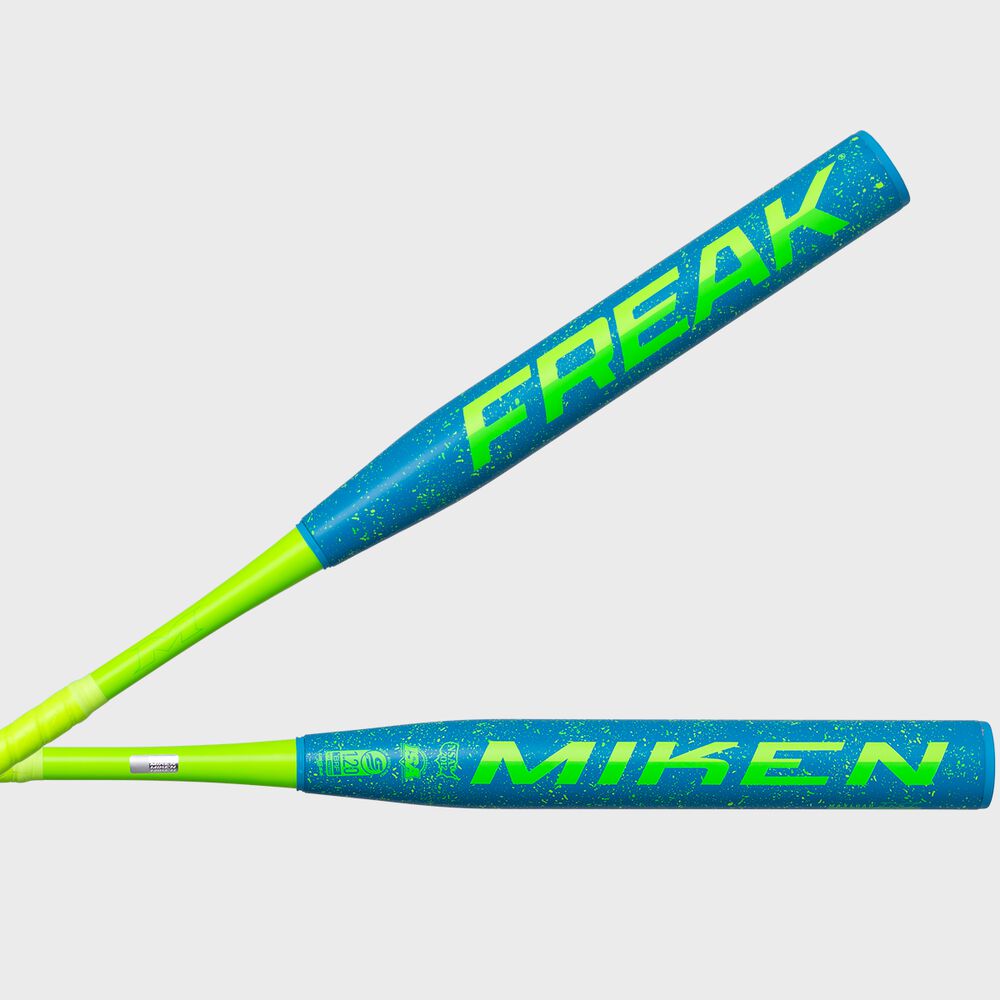
Quick heads up before we get into it: this one’s a slowpitch bat, not fastpitch. I’m including it because it’s one of the clearest examples of two-piece construction done right, and the flex-versus-stiffness tradeoff we’ve been talking about applies the same way whether you play fastpitch or slowpitch.
The old DC-41 Supermax I used to recommend here has been discontinued, so I swapped it out for its spiritual successor: the Miken Freak 2-Piece Maxload, model MSU6FRKL. Miken has kept the Freak name around for over two decades now because the two-piece formula just keeps working.
It’s a true two-piece build, with a composite barrel using Miken’s V2-Flex layup connected to a composite Mid Flex handle through an A1 knob. The barrel runs 2 1/4 inches around and 13.5 inches long, and the Maxload version adds a 0.5 oz end load up top for extra pop on contact.
Like virtually every USSSA slowpitch bat, it’s built at the standard 34 inch length, with weight options at 25 oz, 26 oz, and 27 oz, so you can dial in the swing weight that suits you. It carries USSSA, ISA, and NSA certification.
Pricing runs around $299.99, though Miken and most retailers periodically knock it down from the $329.99 list price. It’s not cheap, but if you want the smoother, whippier feel of a two-piece build backed by a name that’s proven itself for years, it’s worth a look.
Parting Shots
Before getting into a heated battle on “what’s a great softball bat,” you should ask yourself, ‘what do I want?’ Both the one-piece and the two-piece softball bats have their own set of advantages. If you love throwing powerful hits every time the ball comes at you, then the one-piece bat is yours.
But if you don’t like the vibrational feedback from the strike and would rather have a dampener, then go for a two-piece softball bat instead. They also flex more than a one-piece bat. So, it really comes down to your preference and playstyle. Once you understand your own game and get a bat that complements it, you’ll start hitting homers faster and better. Cheers!

With 4 years of Division II experience, a .272 career batting average, .410 on-base percentage, and 7 home runs, I’m now in my fifth season. I’ve played baseball since age 3, alongside future MLB Draft picks, and I aim to pursue a career in baseball professionally, be it playing, coaching, or scouting.